 FR
FR EN
EN ZH
ZH ES
ES AR
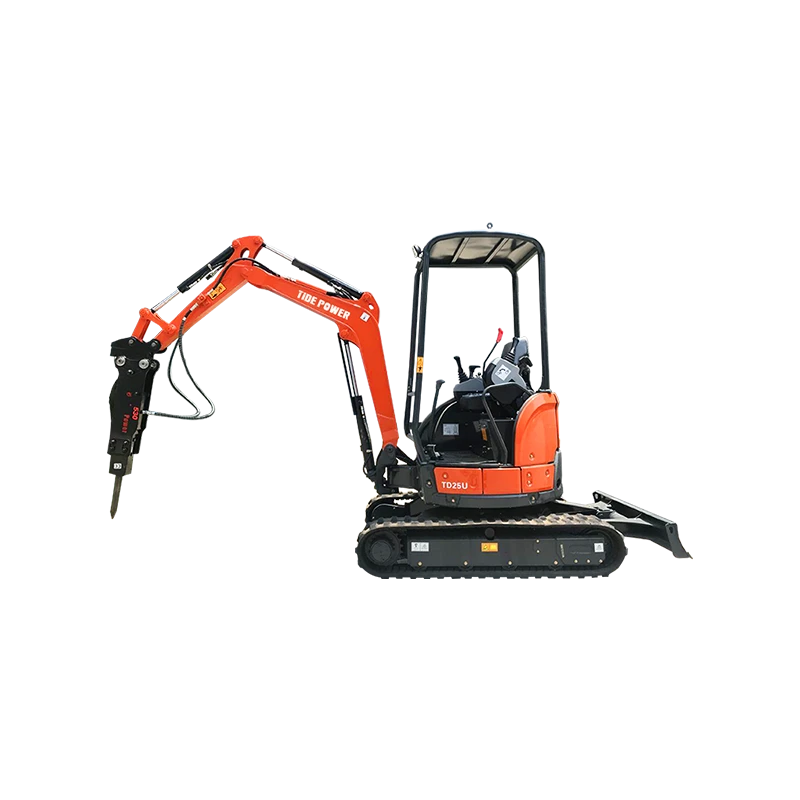
ARMost mini excavator attachment problems start before the machine reaches the jobsite. A buyer specifies a bucket or breaker that looks right, then finds the coupler does not match, the auxiliary flow is too low, or the tool is too heavy for the carrier. The better approach treats the attachment, the carrier model, and the hydraulic circuit as one system. For buyers comparing the Tide Power TD10 à travers TD40U mini excavator range, that means matching each tool to the machine class and the work it will actually perform, not to the longest list of available options.
What Are the Core Mini Excavator Attachment Categories?
Attachment categories divide more cleanly by job function than by name. Most mini excavator attachments fall into four groups: material movement, breaking, drilling, and handling. The common tools and the checks that matter for each group are different enough that buying by name alone creates problems.
| Category | Common tools | Primary compatibility check |
|---|---|---|
| Material movement | Grading bucket, ditching bucket, tilting bucket | Bucket pin spacing and rated lift capacity |
| Breaking | Hydraulic breaker | Auxiliary flow, relief pressure, carrier weight |
| Drilling | Auger drive | Flow and torque at working speed |
| Handling | Thumb, grapple | Control circuit type and mounting bracket |
Buckets are the starting point, but they are not interchangeable by width alone. A narrow ditching bucket cleans out trenches; a wider grading bucket moves material across a surface. Breakers and augers are a different matter. They need a hydraulic connection and a carrier with enough flow to keep the tool at its working speed. Thumbs and grapples are useful for site cleanup, but they need a control circuit that can operate a second function without slowing the boom or dipper arm.
Which Mini Excavator Attachments Suit Which Machine Classes?
Carrier size sets the boundaries for every attachment decision. The Tide Power mini excavator range runs from TD10 to TD40U, and that span matters. A compact TD10 suits lighter trenching buckets and small auger drives. A TD40U has more capacity for a heavier breaker and a larger ditching bucket. Choosing an attachment that exceeds the carrier’s lift capacity or hydraulic reserve creates problems that only appear when the tool is under load.
What changes between a TD10 and a TD40U for attachment choice?
Lift capacity, auxiliary flow, and operating weight all shift with the model. The TD10 works best with attachments designed for the compact class. The TD40U has more headroom for utility work and heavier attachments. In practice, we see buyers choose a breaker rated for a larger machine, then try to fit it on a compact carrier. The immediate problem is not just slow operation but excess load on the boom and a hydraulic circuit that runs hot.
How Do Hydraulic Flow and Couplers Affect Attachment Choice?
Auxiliary flow is the first hydraulic number to check. It tells you how much flow the machine can send to an attachment that needs power, such as a breaker, auger, grapple, or tiltrotator. If the attachment demands more flow than the carrier can deliver, performance falls and heat builds quickly. Pressure matters alongside flow. A breaker with high flow and low pressure will not hit as effectively as a correctly matched breaker at the same machine. Most compact carriers in this class are specified with an auxiliary relief pressure. We compare that number to the attachment’s rated operating pressure, not to the peak pressure on a marketing sheet.
Mechanical vs hydraulic quick couplers: which matters for attachments?
Mechanical quick couplers speed up changes but still require the operator to insert a pin or move a lever. Hydraulic quick couplers change tools from the cab, but they add weight and require another hydraulic circuit. For a machine that changes buckets twice a day, a mechanical coupler usually makes more sense. For a mixed jobsite with frequent changes between bucket, breaker, and auger, the hydraulic coupler earns its cost quickly.
What Should You Verify Before Ordering Mini Excavator Attachments?
Start with the mounting system. Pin diameter, pin spacing, and coupler type must match the excavator arm. A mismatch here is worse than a poor attachment choice because the tool will not physically fit.
- Record the carrier model and exact attachment mounting class.
- Check auxiliary flow and relief pressure from the spec sheet, not the brochure.
- Compare attachment weight with rated lift capacity at the working radius.
- Confirm the control pattern for attachments that need proportional or two way flow.
Are mini excavator attachments interchangeable across brands?
Not by default. Some mounting patterns are common, but coupler and pin dimensions still vary by manufacturer and model. An attachment may fit one TD model and not another. Before ordering, send the carrier model and serial number rather than the brand name alone. That single step prevents most fit and performance problems.
Need a Straightforward Way to Specify Mini Excavator Attachments?
Attachment sourcing is not a single part number problem. It combines carrier specifications, coupler dimensions, hydraulic flow limits, and site conditions. When that information is incomplete, the result is usually a tool that sits in the yard or a machine that runs hot under load. We keep this simple: send the carrier model, the attachments you are considering, and the type of work the machine will perform. We confirm the mounting fit, hydraulic compatibility, and a sensible package for the site.
Email the details to [email protected] or call +86 591 2806 8999. If you are working across multiple machines or bidding an overseas project with mixed attachments, share the fleet list and we will return a short compatibility summary.
cURL Too many subrequests by single Worker invocation. To configure this limit, refer to https://developers.cloudflare.com/workers/wrangler/configuration/#limits
cURL Too many subrequests by single Worker invocation. To configure this limit, refer to https://developers.cloudflare.com/workers/wrangler/configuration/#limits
cURL Too many subrequests by single Worker invocation. To configure this limit, refer to https://developers.cloudflare.com/workers/wrangler/configuration/#limits.
cURL Too many subrequests by single Worker invocation. To configure this limit, refer to https://developers.cloudflare.com/workers/wrangler/configuration/#limits
cURL Too many subrequests by single Worker invocation. To configure this limit, refer to https://developers.cloudflare.com/workers/wrangler/configuration/#limits.
cURL Too many subrequests by single Worker invocation. To configure this limit, refer to https://developers.cloudflare.com/workers/wrangler/configuration/#limits
cURL Too many subrequests by single Worker invocation. To configure this limit, refer to https://developers.cloudflare.com/workers/wrangler/configuration/#limits.
cURL Too many subrequests by single Worker invocation. To configure this limit, refer to https://developers.cloudflare.com/workers/wrangler/configuration/#limits
cURL Too many subrequests by single Worker invocation. To configure this limit, refer to https://developers.cloudflare.com/workers/wrangler/configuration/#limits.
Si cela vous intéresse, consultez ces articles connexes :
Bienvenue au stand Tide Power N2.263 à bauma CHINA 2024
TIDE POWER TP200BESS : Stockage d'énergie intelligent pour générateurs industriels
Tide Power & Lister Petter lancent une solution avancée de puissance au gaz pour une énergie durable
Guide d'entretien estival pour les générateurs électriques à gaz : assurer des performances optimales par temps extrême