
 FR
FR EN
EN ZH
ZH ES
ES AR
ARA pump that cannot hold pressure at the bottom of a deep excavation changes more than the discharge plan; it changes the groundwater control strategy, the fuel burn rate, and the margin for error. High head dewatering pump selection for deep applications should start from one figure that is often missing from bid packages: total dynamic head. Most requests I review list engine power and flow, then treat shutoff head, pump curve, and priming as details to be sorted later. For deep work, those details are the specification. Get them wrong and the engine will run while the pit keeps filling.
What Makes a Dewatering Pump High Head for Deep Work?
A high head dewatering pump is not a standard trash pump with a larger engine bolted on. It is a unit whose pump body, impeller clearance, casing pressure rating, and diesel engine match the pressure required to push water through a long vertical or discharge run. Head is pressure expressed in meters of water column. A deep application asks the pump to overcome static lift from the water surface, friction from long discharge pipe or hose, and any pressure at the outlet, plus a reserve for pump wear and fuel or load variation.
In practice, a pump rated for 60 m total head may be wrong for a 55 m static lift if the discharge line adds 15 m of friction loss. The pump would run near the edge of its curve, flow would fall off, and priming would become unstable as the engine hunts under load. I have seen deep excavation RFQs where the supplier selected the pump at brochure flow without checking the actual curve at the full head. The better sequence is to fix the curve first, then check whether the engine has enough continuous power at that operating point.
How Do You Calculate Head for Deep Applications?
The calculation starts with total dynamic head, often written as TDH. TDH equals static lift plus friction loss plus discharge pressure head plus a small margin. Static lift is the vertical distance from the water surface while the pump is running to the discharge outlet. Because the water surface drops as the pit drains, drawdown must be added to the initial lift. For a deep excavation, drawdown is not a rounding error; it can shift the duty point enough to put the pump outside its useful range.
Friction loss depends on pipe length, internal diameter, couplings, elbows, valves, and pumping rate. A 100 m discharge run with several bends can add more head than the vertical lift in some layouts, and long runs are common in deep sump and mine dewatering. Use the pump curve at the rated speed, not the maximum flow point printed on the spec sheet, and confirm the shutoff head can cover the worst case after drawdown.
| Composant | What the number includes | Common miss |
|---|---|---|
| Static lift | Vertical distance from running water surface to discharge outlet | Ignoring drawdown as the pump drains the excavation |
| Discharge friction | Pipe length, internal diameter, elbows, valves, hose | Estimating based on nominal pipe size instead of internal diameter |
| Outlet pressure | Any pressure at the discharge point | Not counted when a spray bar or treatment connection is later added |
| Suction losses | Strainer, suction line, and inlet losses | Overlooking strainer blockage during operation |
| Duty margin | Wear, engine load variation, fuel quality | Treating margin as optional because the brochure flow looked adequate |
Which Pumsérie p Match High Head Dewatering Duty?
Tide Power groups its diesel engine driven dewatering pumps into Z, B, K, S, D, and C series. The range is built around self-priming pump bodies and diesel engines for continuous and emergency operation. The catalog notes high head and large flow performance, but that does not mean every series fits every deep application. Series selection is a pressure and flow decision first, then an installation decision around suction access, fuel supply, and site mobility.
.png)
For deep sumps with a long vertical lift, the pump curve needs a steep pressure characteristic so the flow falloff is predictable as head increases. For high flow with moderate head, a different series may be more efficient. I do not treat the series names as interchangeable. The right conversation with an engineering contact starts with lift, desired flow, pipe run, and whether the unit will run on diesel or a fixed fuel supply.
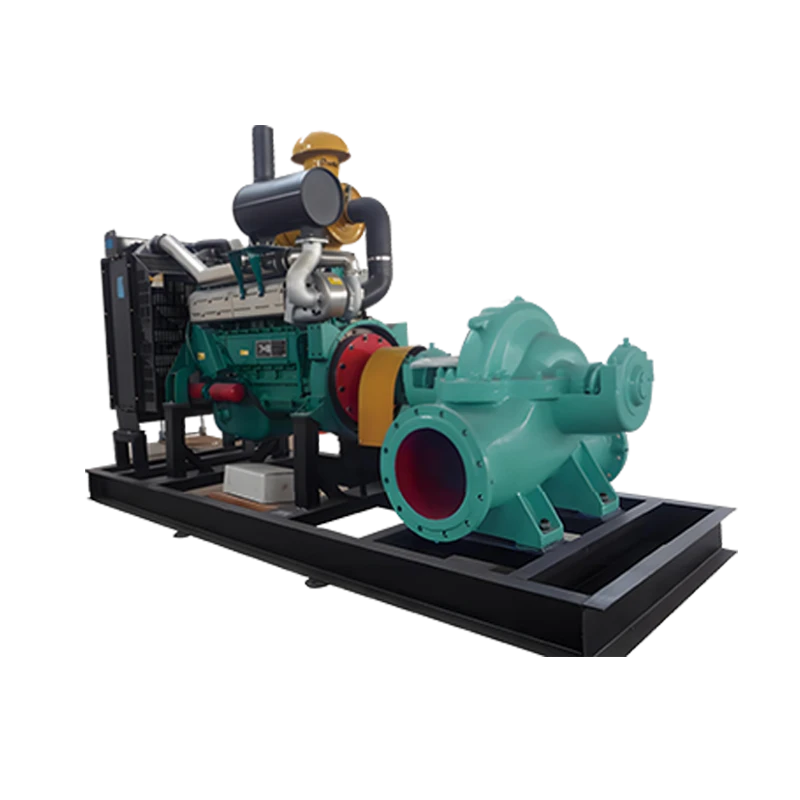
If your deep application includes changes in pit water level, long discharge piping, or solids in the water, it is worth confirming the total dynamic head calculation against the published pump curve before fixing the engine selection. Send the lift, pipe diameter, and target flow to [email protected] and we will confirm the curve match.
What Goes Wrong When a Pump Cannot Hold Pressure at Depth?
The most common failure is not a stopped engine. It is a pump that is running but moving too little water because the selected duty point is outside the pump curve. Deep applications make this worse because as the water surface drops, static lift rises. If the pump was sized for the initial lift before drawdown, it loses flow exactly when the excavation reaches the formation that needs drainage. In several bid packages I have reviewed, the specified pump could handle the starting water level but not the final water level.
Cavitation is a second failure path. At depth, suction line friction, strainer blockage, and high water temperature can reduce the available suction pressure below the margin the pump needs. The pump may rattle, lose prime, or erode the impeller. A deep lift also exposes air leaks in the suction side quickly because a small leak that would not matter on a short lift can break the prime on a long one. The installation must be treated as a system, not a pump and hose picked from separate lists.
.png)
How Should You Compare High Head Dewatering Pump Suppliers?
When I compare quotes for deep applications, I ask each supplier to return the pump curve plotted against the site total dynamic head, not a one-line flow rating. A pump that meets the required flow at 15 m head may be useless at 45 m once drawdown and friction are included. Tide Power carries diesel engine driven dewatering pump series for high head and large flow work, including self-priming units for miniers drainage, flood control, and rescue use. For a specific match, send your lift, discharge line length and diameter, target flow in cubic meters per hour, and site elevation to [email protected] or call +86 591 2806 8999. We will confirm the series and pump curve against the duty point before you commit.
Common Questions About High Head Dewatering Pumps
What is the difference between head and suction lift?
Head is the total pressure the pump must generate, expressed in meters of water column. Suction lift is only the vertical distance from the water surface to the pump inlet. Deep applications can have a moderate suction lift and a very high total head because the discharge side, friction, and drawdown dominate the pressure requirement. A pump chosen for a 6 m suction lift may still be undersized for the total head. The two figures are related but cannot be swapped.
Can a standard dewatering pump be used for a deep application if the engine is larger?
That assumption shows up often in bid documents, and it usually fails. A larger engine adds available power, but the pump casing, impeller geometry, seal pressure rating, and self-priming ability set the head limit. If the impeller cannot develop the required pressure, more horsepower only spins it against a closed curve, wastes fuel, and overheats the water in the casing. The engine and pump end need to be matched at the full head point, not sized only against flow.
cURL Too many subrequests by single Worker invocation. To configure this limit, refer to https://developers.cloudflare.com/workers/wrangler/configuration/#limits
cURL Too many subrequests by single Worker invocation. To configure this limit, refer to https://developers.cloudflare.com/workers/wrangler/configuration/#limits.
cURL Too many subrequests by single Worker invocation. To configure this limit, refer to https://developers.cloudflare.com/workers/wrangler/configuration/#limits
cURL Too many subrequests by single Worker invocation. To configure this limit, refer to https://developers.cloudflare.com/workers/wrangler/configuration/#limits.
Si cela vous intéresse, consultez ces articles connexes :
Tide Power présentera des solutions énergétiques avancées à Nigeria Énergie 2025 à Lagos
Partagez votre histoire ! Célébration de 20 ans de Tide Power
Tide Power et Caterpillar ont signé avec succès un accord d'intention d'achat pour les moteurs MWM 2024
Préparez-vous à découvrir le dernier produit de Tide Power lors de POWERGEN 2025
Guide d'entretien estival pour les générateurs électriques à gaz : assurer des performances optimales par temps extrême
