 EN
 ZH
 FR
 ES
 AR
Renting a 1000kW generator is usually the right call when a project needs about a megawatt of power for weeks or months, when the load is temporary, or when capital approval for a permanent set would arrive too late. The rental decision then turns on four things the site team must confirm before signing: the real load profile, the fuel and refuelling plan, the site’s electrical interface, and who is responsible when the set trips at 2 a.m. Most rental problems trace back to one of those four being agreed verbally rather than in writing.
A 1000kW set sits at the top of the mobile rental fleet. At that size the machine is a transport and infrastructure event, not a piece of equipment you move with a forklift. Rental contracts at this rating are also less standardised than at 100kW or 250kW, so the terms deserve as much scrutiny as the machine.
What a 1000kW set actually delivers on site
Rated power is not the same as available power. A set sold as 1000kW carries a rating defined under a specific standard, and the rating type determines how long you may run it at that figure.
ISO 8528-1 defines the rating categories used across the generator industry, and the distinction that matters most in rental is between prime and standby ratings. A prime-rated set can run at its declared output under varying load for an unlimited number of hours per year, typically with a 10% overload capability for one hour in twelve. A standby-rated set is intended for backup duty at a declared output for a limited annual hours figure, and rental fleets often quote the standby figure because it looks larger on a specification sheet.
A 1000kW standby-rated rental set may therefore be a smaller prime-rated machine inside the same canopy. Ask which rating the rental figure refers to, and ask for the prime figure separately. If the project intends to run the set as the primary power source for a construction phase, the prime rating governs the plan.
| Rating question | What to ask the supplier | Why it changes the rental plan |
|---|---|---|
| Rating basis | Is the quoted 1000kW a prime or standby figure? | Determines continuous duty hours and overload tolerance |
| Voltage and frequency | 400V/50Hz, 480V/60Hz, or another site standard? | Confirms compatibility with the site distribution and installed equipment |
| Alternator and control | Which alternator and controller are fitted? | Affects load acceptance, paralleling options and remote monitoring |
| Fuel tank capacity | Litres installed, plus refuelling arrangement | Sets the refuelling interval and the fuel logistics plan |
| Enclosure rating | Acoustic canopy or open set, and the stated dB(A) at 7m | Decides whether the set can sit near the work area or needs a remote pad |
| Delivery configuration | Complete set, or engine and alternator shipped separately for site assembly | Changes transport, crane and commissioning scope |
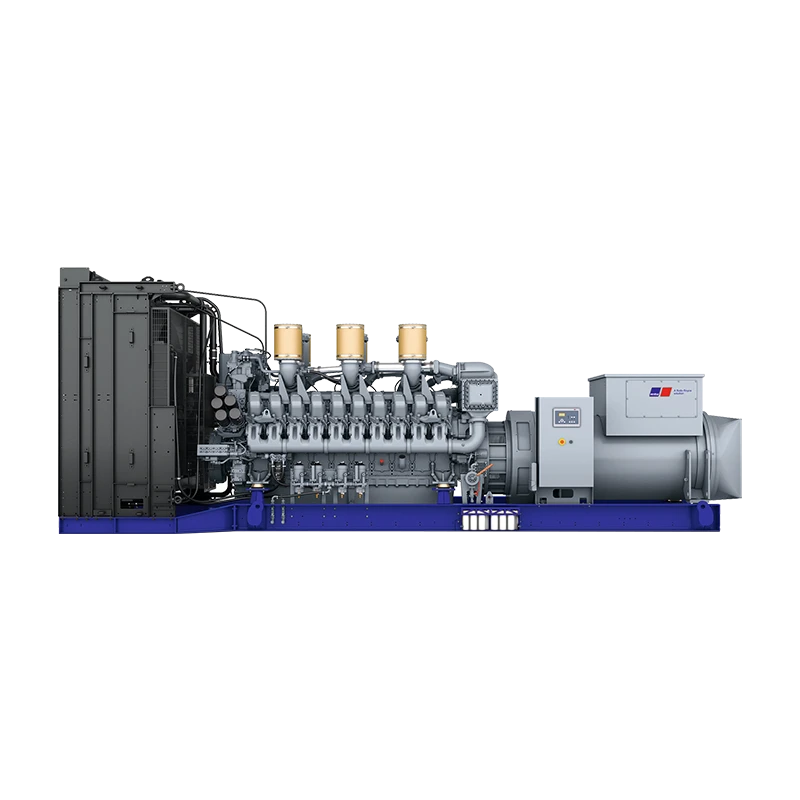
At this rating, transport and rigging frequently cost more than the generator itself over a short rental. Confirm the delivered configuration before pricing: a complete 1000kW set in an acoustic canopy, an open set, or a knocked-down package assembled on site are three different logistics problems.
Sizing a 1000kW rental against the real load
A megawatt sounds generous until the load list is written down. Most projects that consider this rating arrive at it for one of three reasons: a large single load such as a batch plant or hoist, a group of medium loads started together, or an existing supply that has to be replaced temporarily.
The sizing question is not total connected load. It is the sum of running loads plus the largest starting transient, with margin for the loads that start while others are already running. Motor starting is where the plan usually breaks. A direct-on-line motor can draw six to seven times its rated current during acceleration, and a set that carries a steady 600kW comfortably may still dip when a 200kW motor starts across the line.
Two practical checks reduce that risk before the set is ordered. First, list every load with its starting method, not just its rated power: direct-on-line, star-delta, soft starter or variable frequency drive all place different demands on the generator. Second, identify the largest block of load that will start simultaneously, and treat that as the sizing event rather than the steady-state total.
Where the load list includes several large motors, a soft starter or VFD is often cheaper than renting a larger set. That is a genuine tradeoff, not a recommendation for every site: variable frequency drives introduce harmonics that the generator and the site’s other equipment must tolerate, and they add a failure point of their own.
If the load is genuinely uncertain, a stepped approach is usually better than over-renting. A 1000kW set plus a 400kW unit can cover a phased build-up far more economically than a single oversized machine running at 30% load, because diesel generators running well below their rated output suffer from wet stacking and poor fuel efficiency.
Construction projects that phase their power demand across a build programme often plan the generator requirement alongside the site sequence rather than as a single purchase. <Powering the construction industry with Tide Power> covers how temporary power is staged across construction phases.
Fuel consumption and refuelling logistics
Fuel is the largest running cost in a 1000kW rental and the one most often underestimated at the quotation stage. The set’s specific fuel consumption varies with load: a diesel generator running at full rated output is more fuel-efficient per kWh than the same machine at half load, even though it burns more litres per hour.
Published consumption curves for diesel generator sets generally show specific fuel consumption in the region of 200 to 220 g/kWh at rated load for larger sets, rising noticeably as load falls below about 50%. For planning, ask the rental supplier for the consumption curve at 25%, 50%, 75% and 100% load rather than a single figure, then multiply by the expected load profile rather than the rated power.
Refuelling logistics decide whether the rental is viable. A base fuel tank integral to the set covers hours, not days, at this rating. Sites typically require an external bulk tank or a scheduled refuelling arrangement, and both need space, bunding and access for a fuel truck. Confirm three things in writing: the installed tank capacity and its runtime at the expected average load, who owns the refuelling responsibility, and the delivery lead time for a bulk fuel drop.
Fuel quality also matters more than it does on a small portable set. Water, sediment and microbial growth in a bulk tank reach the injection system, and a 1000kW common-rail engine is far less forgiving of contaminated fuel than an older mechanical unit. Specify the fuel standard, confirm the tank has a water trap and filter, and agree who tests the fuel if contamination is suspected.
The site’s electrical interface
The generator is one half of the connection; the site distribution is the other. At 1000kW, the interface is usually a dedicated transformer, a main switchboard, or a temporary distribution board rated for the full current, and the cable run is a significant item in its own right.
The calculation is straightforward and worth doing explicitly. For a three-phase set, current in amperes equals the power in watts divided by the product of line voltage, square root of three, and power factor. A 1000kW set at 400V with a 0.8 power factor delivers roughly 1,800A at full load. That current determines the cable cross-section, the switchgear rating and the earthing arrangement, and it is far beyond what temporary distribution hired at 400A can carry.
Three interface items cause most commissioning delays. The first is voltage and phase compatibility: a set configured for 480V/60Hz cannot serve a 400V/50Hz installation without a transformer, and rental fleets in different regions are configured differently. The second is the neutral and earthing arrangement, which must match the site’s protection scheme and be agreed with the electrical contractor rather than the generator supplier alone. The third is the connection point itself: a 1000kW set needs a properly rated breaker, not a set of temporary tails.
Physical siting belongs in the same conversation. An acoustic canopy reduces noise but does not eliminate it, and the set needs exhaust clearance, cooling air inlet and outlet paths, and a hardstanding that can take the weight and vibration. Fuel and exhaust must be kept away from air intakes and occupied areas, and the set’s position determines the cable route length, which is itself a voltage-drop consideration.
Which rating and duty the rental contract should state
The rental agreement is where the technical plan either holds or collapses. At 1000kW, contracts are often drafted from a template written for smaller sets, and the gap between the template and the project shows up in the first week.
| Contract item | What a site team should require | Consequence if left vague |
|---|---|---|
| Rated output basis | Prime or standby, stated explicitly with the standard referenced | Dispute over allowable running hours and load |
| Availability and uptime | Defined response time for breakdowns, with the supplier’s location noted | Days of downtime with no contractual remedy |
| Fuel responsibility | Who supplies, who owns the bulk tank, who tests quality | Refuelling delays or contaminated fuel disputes |
| Maintenance scope | Service intervals during the rental, and who performs them | Wet stacking or filter blockage mid-project |
| Damage and condition | Joint inspection records at delivery and collection | Deposit disputes over pre-existing damage |
| Standby arrangement | Whether a replacement set is available and at what lead time | Single point of failure for the whole site |
Two clauses deserve particular attention. The uptime clause should name a response time and, where possible, the service location that makes it achievable; a national supplier with no depot near the site cannot meet a four-hour response commitment. The replacement clause matters because a 1000kW set is rarely duplicated on site, so a failure stops the work rather than reducing it.
Ninety days is a useful planning threshold, though it is not a universal cut-off: below it, rental usually wins on cash flow and avoids a disposal problem at the end of the project. Above it, the arithmetic starts to favour ownership once the full cost of a purchase is included, and the break-even point moves with utilisation hours and fuel price.
Rental versus purchase choices depend heavily on how long the load persists and how utilisation changes over the project. <1000kW Generator Rental Price Guide> covers how rental pricing structures are typically assembled for this power class.
When a hybrid or battery system beats renting a bigger set
Some 1000kW enquiries come from a load that is large but brief, or large and spiky. In those cases the obstacle is not the generator’s capacity but its behaviour: a diesel set running at low average load for long periods is inefficient and prone to wet stacking, while one sized for the peaks is oversized for the rest of the day.
A hybrid arrangement changes the arithmetic. A smaller generator running at efficient load, paired with battery storage that absorbs the peaks, can cover a load profile that a single 1000kW diesel set would cover badly. The generator runs in its efficient band, the battery supplies the transient, and fuel consumption falls accordingly.
This is not a universal recommendation. Hybrid systems add capital and complexity, they need space for the storage, and the control system has to be commissioned properly. For a short, high-load, steady rental of a few weeks, a single diesel set remains the simpler and usually cheaper answer. The hybrid case strengthens when the load profile is genuinely spiky, when the rental is long enough to justify the extra equipment, or when the site needs quiet or low-emission operation near occupied buildings.
Tide Power builds hybrid power systems in the 10kVA to 250kVA range, which serves smaller remote and off-grid loads rather than a full megawatt requirement. That makes hybrid an option for the peripheral loads around a large site, or for the battery-backed portion of a spiky profile, rather than a direct substitute for a 1000kW rental.
Questions buyers ask before signing
What does a 1000kW generator actually power?
Around a megawatt covers a large construction phase, a batch plant with several motors, a data hall’s temporary load, or a factory line during a supply upgrade. The exact figure depends on starting currents and simultaneity, not on adding up nameplate ratings. Write the load list before choosing the rating.
Is prime or standby rating the right basis for a rental?
For any use where the generator is the main power source, insist on the prime rating. A standby-rated figure quoted as the headline number flatters the machine and can mislead the sizing calculation. Ask for both figures in writing, and treat the prime rating as the planning number.
How much fuel will a 1000kW set burn per day?
It depends on average load, not rated power. Ask the supplier for the consumption curve at several load points, then apply the expected duty cycle. A set running near rated output burns more litres per hour than one at half load, but less fuel per kWh delivered, which is why running a large set lightly loaded is poor practice in both cost and maintenance terms.
Can a 1000kW set be paralleled with an existing supply?
Paralleling is technically possible and common on larger sites, but it requires compatible controllers, synchronising equipment and a protection scheme designed for it. It is a commissioning project, not a plug-in option. Raise it with the supplier during the quotation stage, not after delivery.
What are the most common rental failures at this rating?
Fuel contamination, undersized site cabling and a mismatch between the quoted rating and the duty the site actually runs. Each is preventable by asking the questions in this article before signing. The common thread is that the technical scope was agreed verbally and not written into the contract.
If your project is at the point of confirming a large rental, send the load list with starting methods, the site voltage and frequency, the expected duty hours, the fuel arrangement, and the intended rental duration to Tide Power at [email protected] or +86 591 2806 8999. Those five items are enough to check whether a 1000kW set is the right rating or whether a different configuration serves the project better.
If you’re interested, check out these related articles:
Animal Breeding Project in Vietnam
Tide Power Heavy-Duty Solutions for Industry