 EN
EN ZH
ZH FR
FR ES
ES AR
ARSelecting the right dewatering pump is seldom a simple comparison of head ratings. It is a procurement decision that shapes fuel budgets, project timelines, and site safety. A high head dewatering pump delivers the pressure needed for deep excavation drainage or long discharge lines, while standard pumps handle moderate lifts with better fuel economy. The critical task is matching total dynamic head and flow requirements to site conditions — a step many project teams rush, resulting in costly misapplications. Based on experience with global energy infrastructure projects, this article examines how to choose between high head and standard dewatering pumps from a project performance and sourcing standpoint.
When Should You Use a High Head Dewatering Pump?
Standard dewatering pumps typically operate effectively up to 20–30 meters of total head. Beyond that threshold, a high head pump becomes necessary to move water against greater static lift or friction loss. In deep open-pit mining, tunnel construction, or long-distance discharge applications, a high head pump keeps the water moving where a standard model simply cannot deliver.
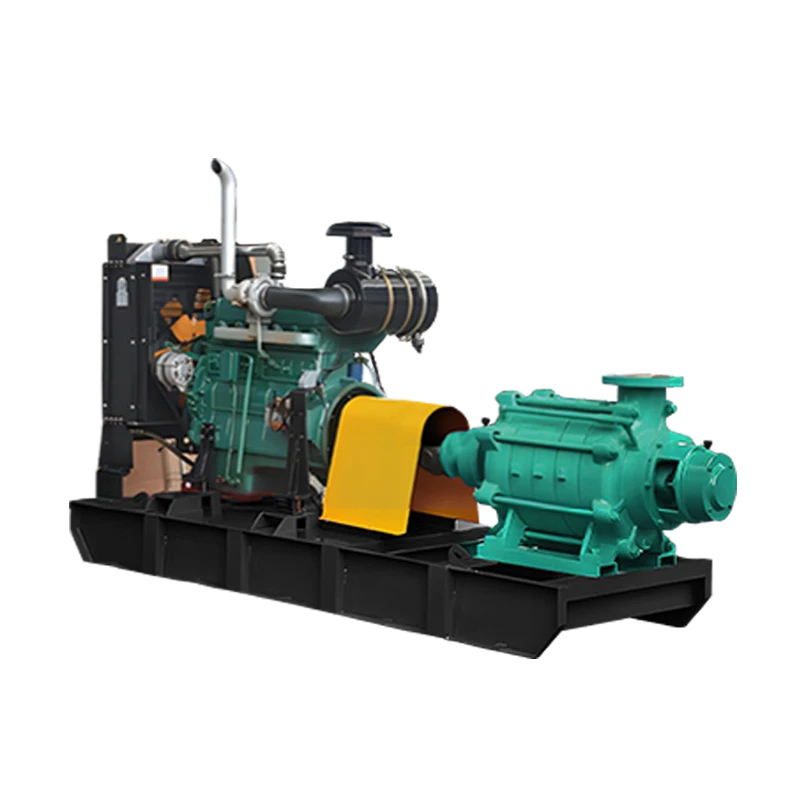
Tide Power’s D Series multi-stage pump units, for example, are built for these high-head applications. They combine efficient impeller staging with heavy-duty diesel engines to sustain steady performance under demanding suction conditions. Other product lines like the Z Series and C Series offer different head and flow combinations to cover medium-to-high lift requirements.
However, the head rating on the datasheet is only one factor. Matching the pump to the actual total dynamic head of the site prevents oversizing — one of the most frequent and expensive mistakes I see in international projects. Oversizing burns extra fuel without delivering any operational benefit.
How Do You Calculate Total Dynamic Head for Your Site?
Total dynamic head is the sum of static head, friction head, and velocity head. For most dewatering applications, velocity head is negligible. The static head is the vertical distance from the water surface to the discharge point, and friction head accounts for pipe length, diameter, and fittings.
A straightforward method engineers use is:
– Measure the static lift. For example, 15 meters from water level to ground surface.
– Add friction losses based on pipe schedule — roughly 10 meters for 100 meters of 6-inch hose with standard fittings.
– Include a 10–15% safety margin.
So, a site requiring 25 meters of static lift plus 10 meters friction loss demands a pump capable of at least 35 meters TDH. A standard pump rated for 25 meters will fail. A high head pump rated for 40 meters delivers the necessary margin without pushing into wasteful overshoot.
| Parameter | Standard Pump Typical Range | High Head Pump Typical Range |
|---|---|---|
| Max Head (meters) | 20–30 | 40–120+ |
| Flow Rate (m³/h) | 30–200 | 10–100 |
| Engine Power (kW) | 5–30 | 20–100+ |
| Fuel Consumption (L/h) | 2–8 | 8–25 |
Supply partners can offer pump curves showing flow at various head points. Use these curves to confirm that your target flow rate is achievable at the required TDH before finalizing procurement.
What Are the Operating Cost Differences Between High Head and Standard Pumps?
Higher head capability demands more energy. A diesel-driven high head pump can consume 50–100% more fuel than a standard pump under comparable flow conditions because the engine must work harder to maintain discharge pressure. Over a month of continuous operation on a large construction site, that differential can add tens of thousands of dollars to the fuel budget.
Maintenance intervals shift as well. High head pumps experience increased stress on impellers and seals, requiring more frequent inspections. Tide Power designs its high-head pump units with large access doors and super-large fuel tanks to reduce service downtime, but project planners still need to budget for shorter maintenance cycles compared to standard models.
One of the most overlooked costs is the penalty of running a pump with insufficient head. When a standard pump is forced to operate beyond its design head, cavitation accelerates impeller wear and shortens engine life. A short-term savings on pump purchase turns into a long-term repair expense.
If your program involves variable water levels or changing discharge distances, confirming the pump’s full head-range performance before finalizing the bill of materials is essential. Reach out at [email protected] for a technical assessment that matches your site conditions.
How Can You Source Reliable Dewatering Pumps for Global Projects?
For international procurement, pump specifications are only one piece of the reliability puzzle. The supplier’s manufacturing standards, engine sourcing, and after-sales support network determine whether the equipment will keep your project on schedule.
Look for suppliers with ISO 9001-certified production and a diversified engine portfolio that includes globally recognized brands like Perkins, DCEC, or Lister Petter. These engines have service networks in remote mining and construction regions, cutting the risk of extended downtime.
Tide Power’s dewatering pump range — covering Z, B, K, S, D, and C Series — is built with modular engine options and engineered for harsh environments. The company’s global distribution and technical support team can assist with configuration, on-site commissioning, and spare parts logistics. That capability matters when a pump failure three months into a project could delay a multi-million-dollar operation.
I’ve seen projects where the initial low-cost pump became the most expensive line item after adding emergency air freight for replacement parts and the lost productivity from unplanned shutdowns. Choosing a supplier with a responsive global network is a decision that directly protects project margins.
For detailed specifications on Tide Power’s dewatering pump lineup, send your head, flow, and site condition requirements to [email protected] or call +86 591 2806 8999. Our engineering team will recommend the appropriate series and engine configuration, making site drainage one less variable in your project’s success.
Common Questions About Dewatering Pump Selection
Can a standard dewatering pump ever handle high-head applications?
No. Standard pumps are not designed for sustained high-head operation. Running a standard pump beyond its rated head starves the impeller of net positive suction head, leading to cavitation and rapid component failure. If your site requires lifts above 30 meters, a high-head model is a necessity, not an option.
What maintenance routines extend the life of a high-head pump well beyond average?
Regular inspection of seals, bearings, and impeller clearances is critical because high pressure accelerates wear. Changing engine oil and fuel filters on the manufacturer’s schedule prevents engine-related failures. A common oversight is neglecting the priming system. Diesel-driven self-priming pumps like Tide Power’s Z Series and B Series demand periodic checks on the vacuum pump or diaphragm to maintain fast, reliable priming under load.
Is a diesel or electric high-head pump better for remote sites?
Diesel pumps offer independence from grid power, making them the default for remote construction and mining projects. Electric pumps can be economical where a stable power supply exists, but for temporary dewatering where mobility and fuel availability drive operations, diesel engine-driven pumps with long-range fuel tanks remain the practical choice.
How do I decide if a multi-stage high-head pump is necessary?
If your required TDH exceeds the capability of a single-stage centrifugal pump — typically above 60–80 meters — a multi-stage unit like Tide Power’s D Series becomes the appropriate choice. Multi-stage pumps stack impellers in series to build pressure incrementally while maintaining manageable flow. They carry a higher upfront cost but deliver the head performance that single-stage models cannot match.
What causes a dewatering pump to lose prime, and how can it be prevented?
Loss of prime often results from air leaks in the suction line, a clogged strainer, or a worn foot valve. In self-priming pumps, a damaged diaphragm or worn clearances in the priming chamber also cause prime failure. Regularly tightening suction couplings, cleaning strainers, and testing the priming system under load are low-cost practices that prevent repeated shutdowns. If you encounter recurring priming issues, share your pump’s setup with a technical team — a small adjustment often resolves the problem without replacing the unit. Provide your current configuration, and we can help diagnose the root cause.
If you’re interested, check out these related articles:
Tide Power Annual Team Building was a resounding success
Installation of Tide Power Generator Sets at a South American University
Tide Power & Lister Petter Launch Advanced Gas Power Solution for Sustainable Energy