 EN
 ZH
 FR
 ES
 AR
Choosing a light tower manufacturer comes down to one question: can the supplier show, in documents you can check, that the unit will put usable light on your working area for the hours you actually run it? Lumen figures and unit prices are easy to quote and hard to compare across offers. A photometric layout, a deployed wind rating, the rating category behind a quoted kilowatt figure, and a written service commitment are what separate a manufacturer who still answers in year three from a seller who forwards your email and waits. The checks below follow the order a site team can complete them, from the first screening call to the clauses worth signing.
What separates a light tower manufacturer from a trading company
Many companies sell light towers without controlling how the mast, canopy or control panel is built. That becomes expensive at the first specification change or the first failed part, because every question passes through another business before it reaches anyone who can answer it.
Four questions sort this out quickly. Who owns the drawings? Who assembles and welds the mast sections? Who performs the electrical test and signs the test report? Who holds spare parts for the model being quoted? A manufacturer can answer all four without forwarding the message. A trading company usually answers the first and redirects the rest.
Capacity is a different question from capability. A supplier with its own production line can describe monthly output, the surface treatment process, and what happens to lead time when a mast height changes. Companies that invest in production also tend to publish something about it, and a dated public record gives you a reference point to compare against the answer you receive.
Production investment is one of the few capability claims a supplier can date and document. <Tide Power Breaks Ground on New Smart Generation Equipment Manufacturing Hub> covers the company’s new smart generation equipment manufacturing hub and its groundbreaking.
None of this replaces a factory audit, but it removes the sellers who cannot survive a five minute screen.
Start with the lighting task, not the lumen number
The lumen figure on a datasheet describes the output of the LED modules. It does not describe what reaches the ground. Illuminance, measured in lux, changes with the distance from the fixture, the shape of the optic, the aiming angle, and the maintenance factor allowed for dirt and lumen depreciation. Two towers quoting the same total lumens can deliver noticeably different light at the working plane once the beam angles differ.
So specify the task before the product. What work happens under the tower: bulk earthworks, concrete finishing, steel erection, night loading, or event staging? How large is the area that needs task light, and is there a separate requirement for general compound illumination and safe movement between zones? Those answers decide mast height, fixture count and beam distribution together. Fixing any one of them first constrains the other two.
EN 12464-2 sets maintained illuminance values for outdoor work places by task and area [1]. A manufacturer designing to it should be able to name the task class the proposed configuration targets, and to state the value the design maintains rather than the value measured on a new unit in a test hall.
Lux at the surface versus lumens at the lamp
An average lux figure still hides two things that decide whether a site is comfortable to work in: uniformity and glare. Uniformity compares the lowest grid value with the average, and a tower that meets an average target while leaving dark patches between pools of light creates trip hazards and forces rework. Glare behaves differently from a meter reading, because an unshielded fixture aimed across a work area can register as bright while the operator looks away from it.
Ask how the fixtures are aimed, whether the design includes shields or visors, and how light spill is controlled at the site boundary. Neighbouring housing and nearby roads are the usual source of complaints, and they are easier to design out than to correct after installation.
What a lighting layout should show
Ask for a photometric layout calculated at your mast height, over your site dimensions, with calculated lux on a grid, the uniformity ratio, the aiming plan, and the maintenance factor used. A layout produced at a different mast height, or with a maintenance factor of 1.0, is not evidence for your site.
Match the power source to the site, not the brochure
Four configurations cover most sites, and the choice should follow the duty cycle rather than a preference for one technology.
| Configuration | Fits when | Runtime limit set by | Main trade-off |
|---|---|---|---|
| Diesel | Long nightly duty, refuelling access, manageable ambient heat | Tank capacity and load, with derating in heat or at altitude | Engine and exhaust noise, plus fuel logistics |
| Battery only | Short shifts, noise-sensitive or enclosed surroundings | Usable capacity, allowed depth of discharge, recharge window between shifts | Charging infrastructure and pack replacement cost |
| Solar with battery | Remote sites with reliable daily sun and a modest nightly load | Panel wattage, pack capacity and seasonal insolation | Reduced autonomy in low-light months and a larger footprint |
| Hybrid solar, battery and generator | Variable duty, no grid, quiet hours that must be respected | Control logic that decides when the generator starts | Higher capital cost and more control hardware to maintain |
A solar configuration removes the fuel run entirely, at the cost of a sizing exercise that has to survive the worst month rather than the best one. Nightly output depends on panel wattage, usable battery capacity and the insolation at the site, which changes with latitude and season.
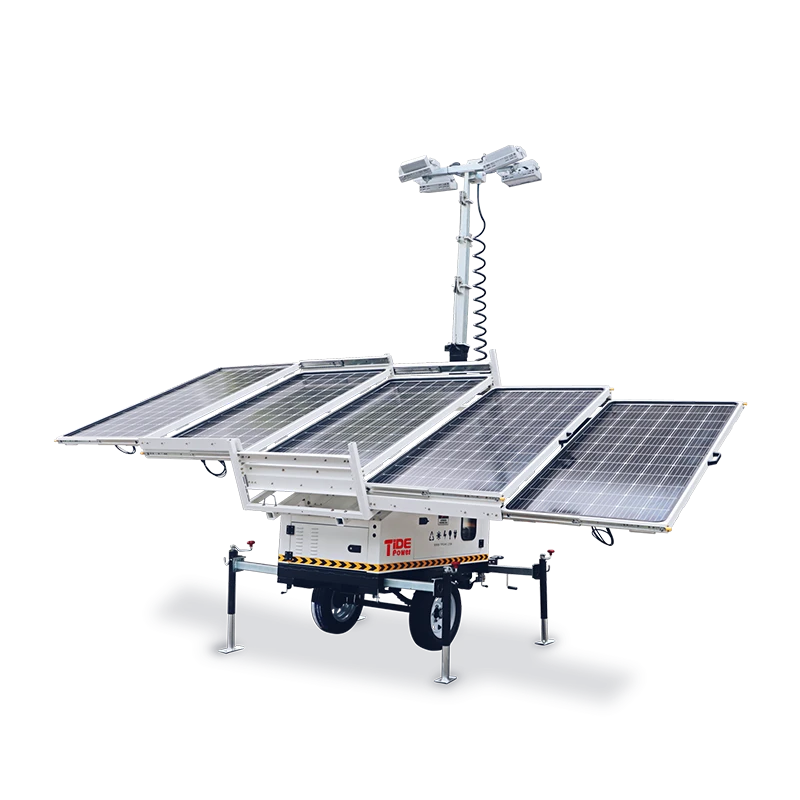
A hybrid unit adds a small generator to the battery bank, so the generator runs only when the battery cannot carry the load. The control logic behind that decision carries most of the operating cost, and it is worth asking what the switchover threshold is and whether it can be adjusted on site.
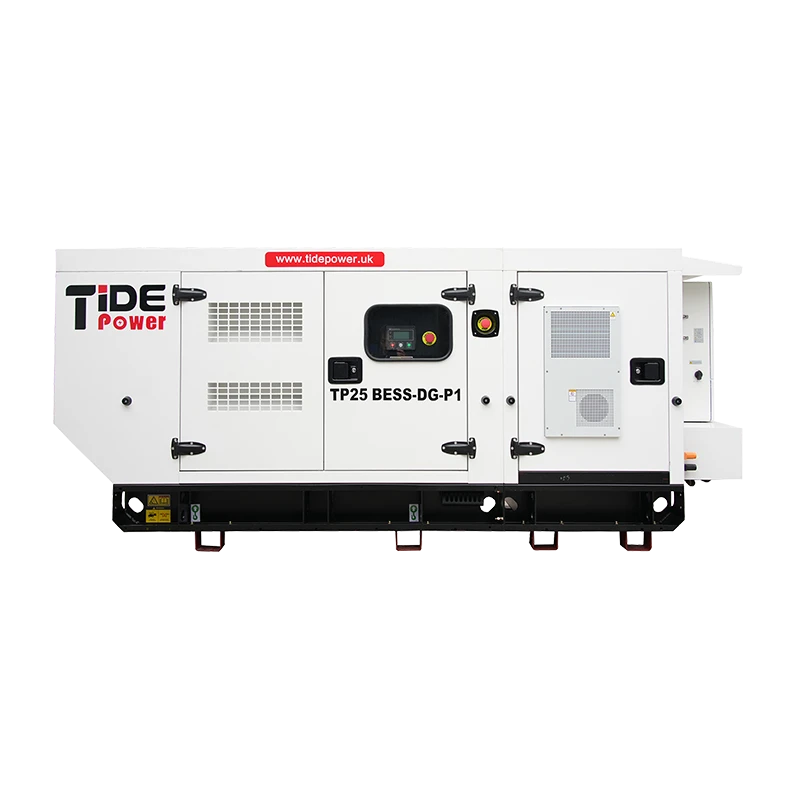
The quoted kilowatt figure deserves a second look. ISO 8528-1 defines rating categories for generating sets, and those categories are not interchangeable [2]. A rating intended for limited hours and a rating intended for continuous supply can appear as the same number in a comparison table, and the difference shows up later as overheating, derating or a shorter engine life. Ask which category the figure refers to, and at what ambient temperature and altitude it applies.
Mast, chassis and enclosure questions that decide site safety
Mast height is the least informative number on a specification sheet compared with what happens when the wind rises. A deployed mast is a lever: the load at the top is multiplied by the height, and the outriggers, ballast and chassis have to resist the result. Ask for the rated wind speed with the mast fully deployed, the basis for that rating, and the ground condition it assumes. A rating that assumes outriggers on level, compacted ground is not valid for a unit standing on soft fill.
In Europe, wind action is normally assessed using the method in EN 1991-1-4, which treats basic wind velocity, terrain and height above ground [3]. You do not need to reproduce the calculation. You do need to know whether the manufacturer’s figure is a gust or a mean wind speed, and at what height it is quoted, because comparing a gust figure against another supplier’s mean figure flatters whichever number is larger.
Enclosure protection is often compressed into one IP number. IEC 60529 defines the two digits separately, the first for solids and the second for water [4]. A light tower may carry one rating for the lamp housing and a different rating for the control panel, and the lower of the two governs the parts most likely to fail. The IP rating also says nothing about the mast sections, the chassis coating or the hydraulic hoses, which face the same weather without a test standard behind them.
Hydraulic, manual or horizontal mast
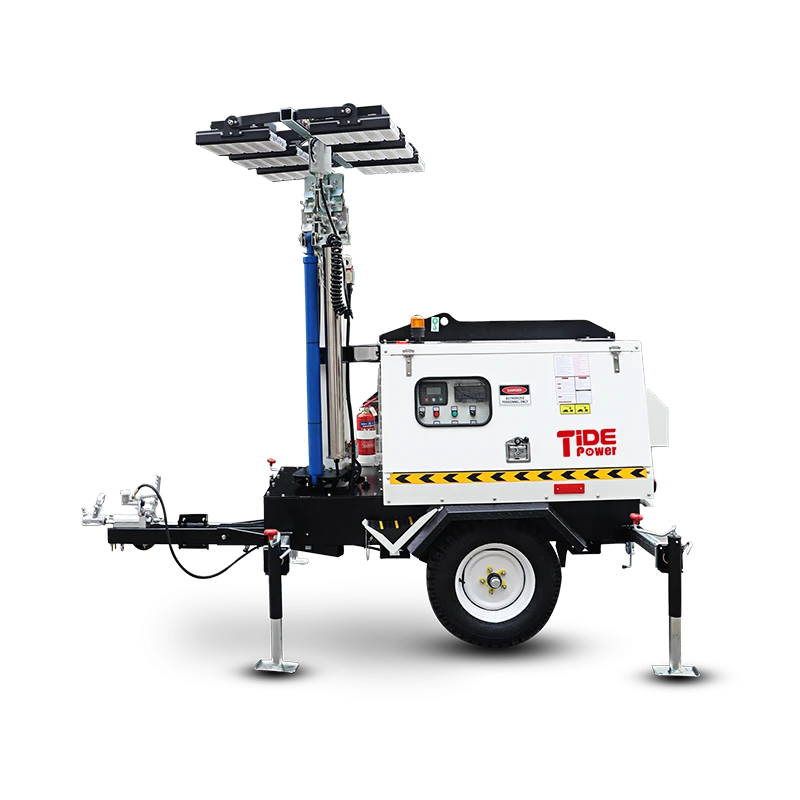
A manual mast uses a winch or hand crank, which removes cylinders, seals and hoses from the maintenance list but adds time to every deployment and more physical effort per shift. A hydraulic mast deploys faster and lets one person raise the light bar, at the cost of cylinders, seals and hoses that need a service interval and a spare parts source. A horizontal mast stows the light bar closer to the chassis, which lowers transport height and simplifies container loading, though it can add handling steps at deployment.
Transport and stowage checks
Towing speed, braking system, lighting board, gross vehicle weight and container loading all affect cost before the first night shift. Ask for the stowed dimensions, the unladen weight, the number of units that fit in a 20 ft or 40 ft container, and the lifting points. A tower that needs a low loader for every site move carries a transport cost that rarely appears in the quotation.
Specifications to request in writing before you compare quotes
Once the task, power source and mast are settled, the comparison moves to documentation. The fields below decide whether two quotes can be compared at all.
| Field to request | What it should contain | Failure it prevents |
|---|---|---|
| Photometric layout | Calculated lux grid at the working plane, uniformity ratio, aiming plan, maintenance factor | Comparing source lumens instead of delivered light |
| Power source rating | kW or kVA with the rating category and the reference standard | A limited-hour rating priced as continuous duty |
| Autonomy | Hours per tank or charge at a stated load, ambient temperature and depth of discharge | Runtime claims that assume an ideal day |
| Mast wind rating | Deployed wind speed, gust or mean basis, outrigger and ground assumptions | An unrated mast on an exposed site |
| Enclosure protection | Separate IP ratings for lamp housing and control panel | One number applied to parts that do not share it |
| Spares and lead times | LED module, controller, seal kit, battery, each with a delivery time | A service plan with no parts behind it |
The fastest way to see whether a request is specific enough is to compare a weak line with a usable one.
| Weak request | Verifiable request |
|---|---|
| Four 300 W LED light tower, 9 m mast, 60 hour runtime, CE marked | Four LED fixtures giving [target] lux average over [area] at [height] with a stated uniformity and maintenance factor, mast rated to [wind speed] deployed, runtime of [hours] per [litres] at [load] and [temperature], separate IP ratings for housing and panel, and a test report per unit |
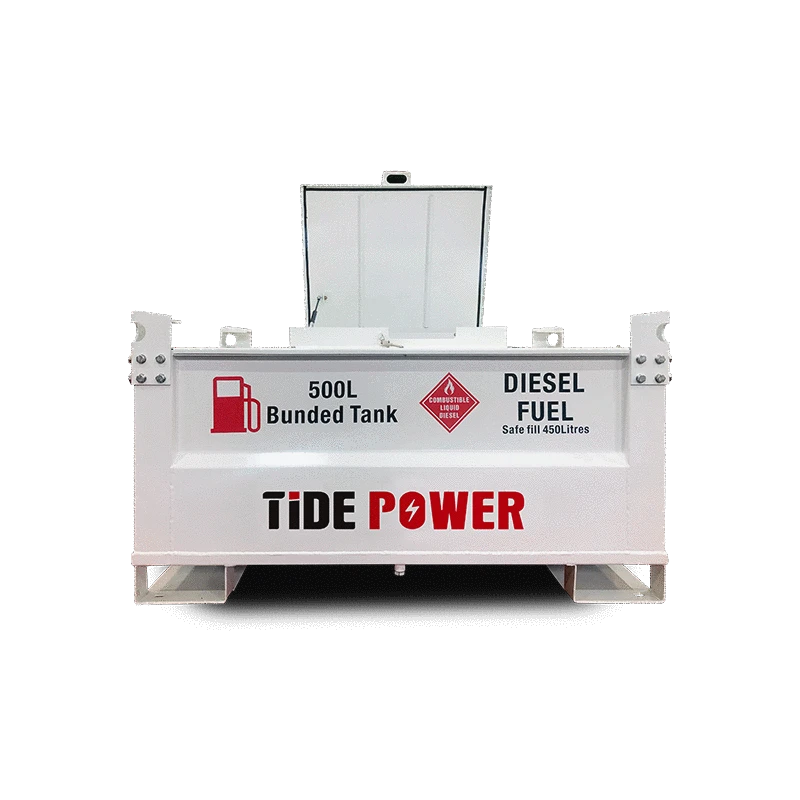
Fuel capacity deserves its own line in the request. Tank size sets autonomy on a diesel unit, but so does the refuelling route: a site that needs a tanker every second night pays for it in labour and in the risk of running dry mid-shift. Ask for the tank capacity, the consumption at a stated load, and whether the tank is a separate certified component or formed by the chassis.
How to verify factory claims without visiting
Certificates and photographs are easy to collect and hard to read. The question to ask of each document is what it can prove and what it leaves open.
| Document or claim | What it can support | What it cannot prove |
|---|---|---|
| ISO 9001 certificate | That a quality management system has been audited within the stated scope | That a specific unit met its photometric or runtime specification |
| Calculated photometric layout | Predicted performance for the stated geometry and maintenance factor | Measured performance of the delivered unit |
| Type test report for the enclosure | The rating of the tested design under the stated conditions | Continued compliance after a design change |
| Reference project in a similar climate | That the product has been supplied into that environment | That the same outcome will repeat on your site |
| Factory photographs or video | That a production area exists | Capacity, process control or test procedure |
Two reference calls do more than any brochure, provided you ask specific questions: how many units were bought, in what conditions, what failed first, how long the replacement part took to arrive, and whether measured runtime matched the quoted figure. A buyer who will not discuss failures is telling you something too.
If the project involves a fleet rather than a single unit, ask how the manufacturer handles mixed configurations across one site and whether the same controller and spares set carry across models. Configuration control across a fleet is a different capability from building one good unit.
Fleet deployments test a supplier’s configuration control as much as its hardware. <Case Study: Scalable Generator Systems for Every Urban Power Challenge> covers a case study on scalable generator systems for urban power challenges.
Warranty, spares and service terms that decide total cost
Lifecycle cost on a light tower sits mostly outside the purchase price: fuel or charging, battery replacement, LED module replacement, service visits and downtime. The warranty terms decide who pays for which part of that.
Read the warranty as three separate lists: what is covered, for how long, and who performs the work. LED modules, batteries and hydraulic seals are commonly treated as wear items with shorter cover than the structure. Labour is often excluded even when parts are covered, which turns a free part into a paid callout. Ask for the response time commitment measured from notification rather than from dispatch, and check whether service by a third party affects cover.
Battery replacement is the largest single non-fuel cost on a battery or solar tower. Ask for cycle life at the ambient temperature your site actually reaches, since a figure measured at a comfortable test temperature will not hold in a hot climate, and confirm whether the pack is field replaceable or returns to the factory.
Service quality depends on the technician who arrives. Ask whether the manufacturer trains the people who will attend your site, whether that training covers the controller and the hydraulic system or only the engine, and whether site staff can be trained for first line checks such as lamp module swaps and seal inspection.
Service quality depends on the technician who arrives, and on whether the manufacturer trains that person. <Tide Power Technical Training Conference in South East Asia> covers the company’s technical training conference in South East Asia.
Send your site conditions before you request a quote
Configuration advice is only as good as the inputs behind it. Send the work type under the tower, the area to be lit and the target illuminance or task class, the nightly runtime, the design month for solar sizing, the maximum wind exposure and ground condition, the ambient temperature range, transport or container constraints, and the location where service would be needed. Add the noise limit if the site sits near housing, and the fuel or charging arrangements already available on site. Email [email protected] or call +86 591 2806 8999, and Tide Power can review those conditions against a lighting tower range that covers manual mast, hydraulic, horizontal mast, solar and solar hydraulic configurations.
FAQ
Is a higher mast always better?
No. Mast height trades against stability, transport and cost. A taller mast spreads light over a larger area and lifts the fixtures out of the working zone, but it also increases the wind load on the outriggers and the stowed length on the trailer. For a small compound with demanding task light, a shorter mast with well-aimed fixtures can deliver more usable light than a taller one. Choose the height that clears the working area without over-lighting the surroundings.
How much light does a construction site need at night?
The requirement follows the task rather than a single figure. EN 12464-2 sets maintained illuminance by task and area, and national regulations may add their own minimums, so the value should come from the project safety plan or the client specification. Ask the manufacturer to design to that value, and to state the uniformity and maintenance factor alongside it. Where no value is specified, agree one in writing before the order rather than accepting a default.
Diesel or solar for a remote site?
Runtime, sun and access decide it. Solar suits modest nightly loads with reliable insolation and long gaps between maintenance visits. Diesel suits heavy nightly duty, high ambient temperatures, or sites where fuel delivery is already organised for other equipment. A hybrid covers the middle ground by running the generator only when the battery cannot carry the load. Ask for the design month used in solar sizing and the fuel consumption at your load before comparing prices.
How do I check that a supplier is the actual manufacturer?
Ask who owns the drawings, who welds the mast, who performs the electrical test and who signs the report. Then request the factory licence scope, a recent audit or type test report carrying a serial number, and the spare parts list with lead times. A supplier that redirects those questions is a channel partner, which can still be the right choice, but the price, the warranty and the response time should reflect that relationship.
What warranty terms should I expect?
Cover for the structure and the power source, separate terms for wear items such as LED modules, batteries and seals, a stated response time measured from notification, and a parts list with lead times. Labour cover matters as much as parts cover. Get the exclusions in writing, particularly any clause on service performed by third parties, because that condition can void cover after the first local repair.
References
[1] EN 12464-2:2014, “Light and lighting. Lighting of work places. Part 2: Outdoor work places,” CEN, 2014.
[2] ISO 8528-1:2018, “Reciprocating internal combustion engine driven alternating current generating sets. Part 1: Application, ratings and performance,” ISO, 2018.
[3] EN 1991-1-4:2005+A1:2010, “Eurocode 1. Actions on structures. Part 1-4: General actions. Wind actions,” CEN, 2010.
[4] IEC 60529:1989+AMD1:1999+AMD2:2013, “Degrees of protection provided by enclosures (IP Code),” IEC, 2013.
If you’re interested, check out these related articles:
Intelligent Integration: Tide Power’s All-in-One Solar Container Ensures Uninterrupted Green Power
Join Tide Power at bauma CHINA 2024