 EN
 ZH
 FR
 ES
 AR
An LED light tower cost comparison usually starts with the wrong pair. LED names the lamp; diesel names the engine and alternator behind it. Most diesel light towers sold today already carry LED fixtures, so the two labels rarely describe competing machines. The choice that moves the numbers is a pair of decisions: which lamp technology you run, and where the electricity comes from. Settle the first and the second becomes a duty-cycle question about hours per night, season length, and how easily fuel or charging reaches the site.
Are LED and Diesel Light Towers Actually Two Different Choices
LED is a fixture technology. Diesel is an energy source. One unit can carry both, and the combination is now common rather than unusual, because a lower connected load for the same delivered light lets a manufacturer fit a smaller generator or stretch runtime on the same tank.
The two labels share a conversation because buyers search for the light they want and the fuel they recognise. The trap is treating them as alternatives. A page that sets an “LED light tower” against a “diesel light tower” is usually comparing a battery tower with a diesel tower, or a new tower with an older metal halide unit. Neither comparison isolates the lamp.
Each decision moves a different part of the cost. The lamp sets the electrical load needed for a given amount of light, along with warm-up and restrike behaviour: metal halide lamps take time to reach full output and do not restart instantly after a supply interruption, while LED fixtures come back at full output. The supply sets how the energy is paid for, in litres delivered to site, kWh drawn from a grid connection or site generator, or kWh held in a battery and replenished by solar. Keep those two questions apart and the cost arithmetic starts to behave.
Which Light Tower Configurations Should You Compare
Four configurations cover most sites, and only some of them can be priced against each other directly.
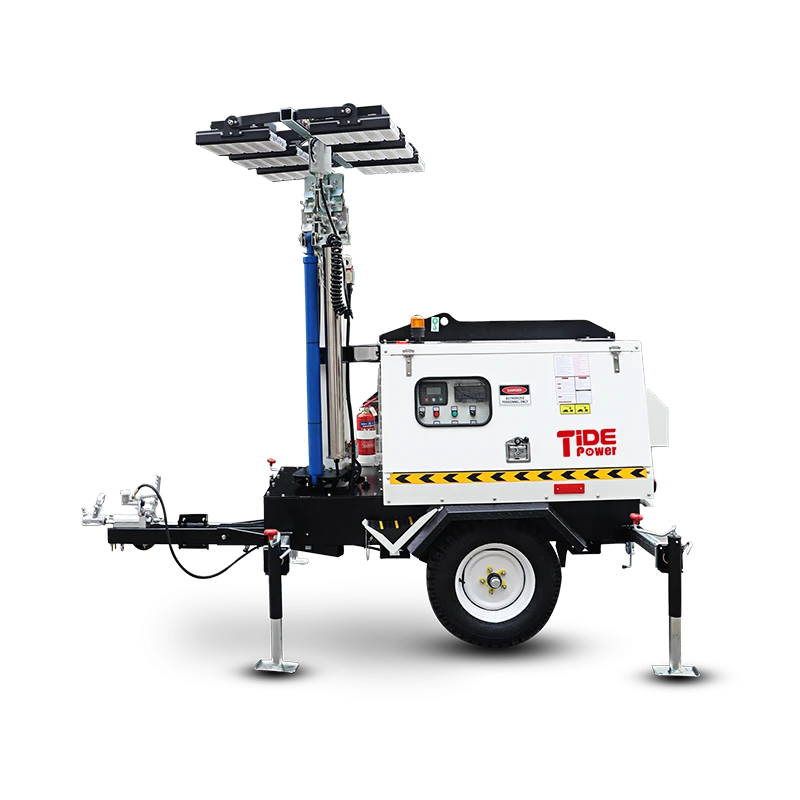
Diesel generator with LED fixtures
The towable mast tower most crews picture. An onboard diesel set feeds LED floodlights mounted on a hydraulic, manual or horizontal mast. Fuel is the energy store, refuelling takes minutes, and the cost profile follows fuel price and hours run.
Battery only with LED fixtures
There is no engine on the unit. A battery pack charged from a site supply or a generator feeds the lamps. The tower produces no engine noise at the point of use and adds no exhaust to the work zone, but the shift has to fit between charges, and the pack becomes a scheduled replacement item rather than a fuel bill.
Solar and battery hybrid with generator backup
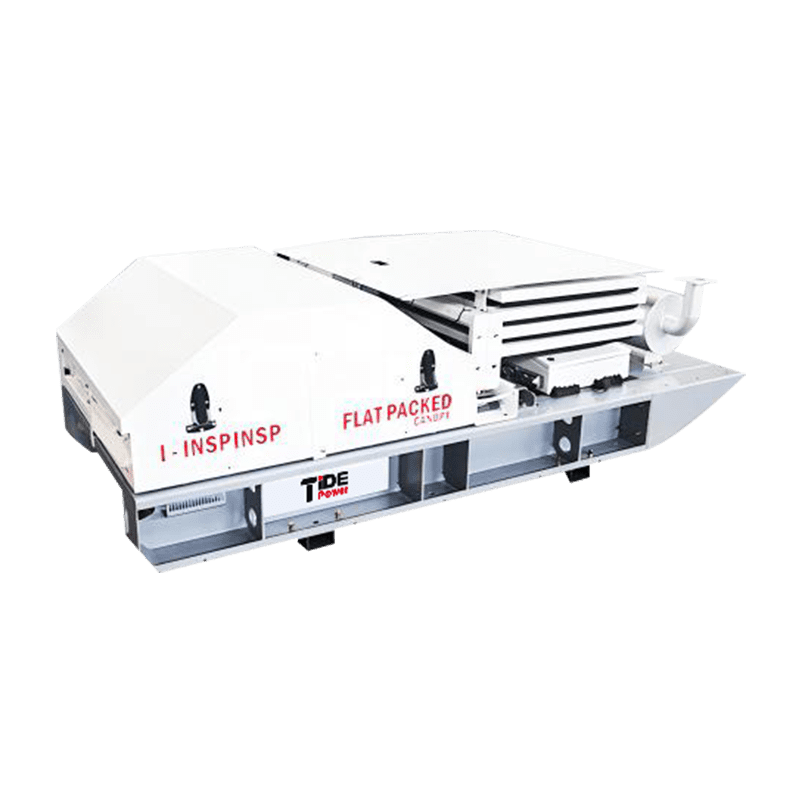
Solar input, a battery and a diesel set in one enclosure. The engine runs at a steady load to recharge instead of idling all night, and unattended operation becomes practical on sites without an operator on shift. All-in-one hybrid units in this class combine the three sources in a single package.
A fourth configuration, a diesel set running metal halide lamps, is now mostly a used-equipment question. It appears in cost comparisons because second-hand towers are cheap to buy, and the fuel and lamp replacement figures usually explain why they are cheap.
Most projects end up running more than one configuration, because a single site rarely has uniform conditions: a lit compound, a dark haul road and a noise-restricted boundary can each call for a different answer.
Running more than one configuration on one site usually means coordinating several suppliers on delivery, commissioning and spares. <Tide Power: Your One-Stop Energy Solution for Every Challenge> covers how a combined energy solution is positioned across different site challenges.
How Do You Compare Cost Per Lit Hour
Purchase price answers a different question from running cost, and the gap between them widens with hours. The unit that keeps the comparison honest is one lit hour: one tower delivering its specified light for one hour.
Start from the light the task requires. Where a jurisdiction sets minimum illumination levels, such as the OSHA construction illumination rule in the United States, the target is a stated level rather than a preference [1]. That figure fixes the delivered light you are paying for, and every configuration can then be measured against the same service.
The arithmetic is simple once the buckets are separated:
Cost per lit hour = (delivered capital + energy + service and parts + site operations + replacement reserve) ÷ total lit hours.
Total lit hours is hours per night multiplied by nights per season and by the number of seasons in the comparison period. The comparison period matters more than any discount. A three-year horizon favours the cheaper capital item. A seven-year horizon that includes one battery replacement can reverse the order, which is why the horizon should be fixed from the contract length or the ownership plan before any quote is compared.
| Cost bucket | What it contains | How to measure it for your site |
|---|---|---|
| Delivered capital | Equipment, masts, fixtures, freight, commissioning, operator training | Quoted price delivered and commissioned, not list price |
| Energy | Diesel litres, or kWh from a grid connection or site generator | Metered fuel and metered kWh across a representative week |
| Service and parts | Engine oil and filters, drivers and fixtures, scheduled battery replacement | Service schedule in engine hours plus quoted parts prices |
| Site operations | Refuelling labour, fuel transport and bunding, charging oversight, relocation time | Logged labour hours and transport cost per move |
| Interrupted lighting | Restrike delay, cold-start failures, charge time longer than the shift | Incident log and hours of lost illumination |
| End of life | Residual value, disposal cost, battery take-back terms | Written resale or disposal terms from the supplier |
Three estimating errors survive most of these comparisons:
- Hours are assumed rather than logged. A tower quoted for eight hours a night often runs ten, and the extra two hours land entirely in fuel, service and cycle life.
- The replacement reserve is left out. The battery is treated as part of the purchase price instead of a cost spread across the lit hours it delivers.
- Interrupted lighting is treated as free. Minutes lost at a refuel, a cold start or a half-charged pack carry a cost on a concrete pour or a night shift, and they belong in the comparison if the site is schedule-critical.
What Drives the Purchase Price of Each Option
A light tower is priced from the light outwards. Fixture efficacy sets how much power is needed for the target illuminance, and that figure sizes everything downstream: the alternator, the tank, the battery or the solar array. This is the mechanism behind the LED premium argument. When the power hardware is right-sized for LED loads, the savings on the generator or battery can offset part of the fixture cost. When a manufacturer keeps an oversize alternator and simply swaps the lamps, the premium stays and the fuel saving arrives slowly.
Engine rating explains much of the price spread between apparently similar diesel towers. A kW figure means little unless the rating class is stated, because ISO 8528-1 defines distinct classes for continuous, prime and limited-time running [2]. A set quoted at a limited-time rating is not the same machine as one quoted at prime rating, even when the figures on the badge match.
Emissions rules add hardware to the price. In markets applying EU Stage V limits under Regulation (EU) 2016/1628, engines used in non-road mobile machinery carry after-treatment that has to be bought, serviced and kept supplied [3]. That cost belongs in the capital line, not in a footnote.
Enclosure, mast and transport configuration account for much of the rest. A sound-attenuated canopy with thick acoustic panels costs more than a plain frame, and the difference shows up in the noise figure that decides whether the tower can work near housing.
Battery capacity closes the list. It is quoted in nameplate kWh far more often than in usable kWh at a stated depth of discharge and temperature, and the second figure is the one that decides whether a shift finishes lit.
How Fuel and Charging Change the Running Cost
Diesel running cost is fuel plus service, and both track hours. Fuel burn follows load with a fixed share that stays even at light load, so a set running well below its rating burns more per kWh delivered than one working near its efficient band. Around the fuel itself sit costs that quotes rarely show: delivery minimums, storage and bunding, losses to theft or contamination, and the labour hours spent refuelling a mast every night.
Battery and solar running cost is charging energy plus a replacement reserve. Charging can be nearly free where a site supply exists and expensive where a generator has to run to charge. Solar input varies with latitude, season and weather, and the winter month at high latitude is usually the constraint that settles the array size. Cold also reduces what a battery can deliver, so a pack sized on a summer trial can fall short on a January night.
Storage is the line item that separates a battery tower from a diesel tower across a multi-year horizon. <Compact BESS: Your Intelligent Route to Energy Independence and Cost Efficiency> covers compact battery storage as a route to energy independence and cost control.
The replacement reserve is where honest arithmetic usually breaks down. A battery is a capital item with a finite cycle life, so its cost belongs in the running comparison as replacement cost divided by the lit hours it delivers before replacement. Leave it out and the battery tower looks cheaper than it is; add it with an inflated cycle count and the diesel tower looks better than it is.
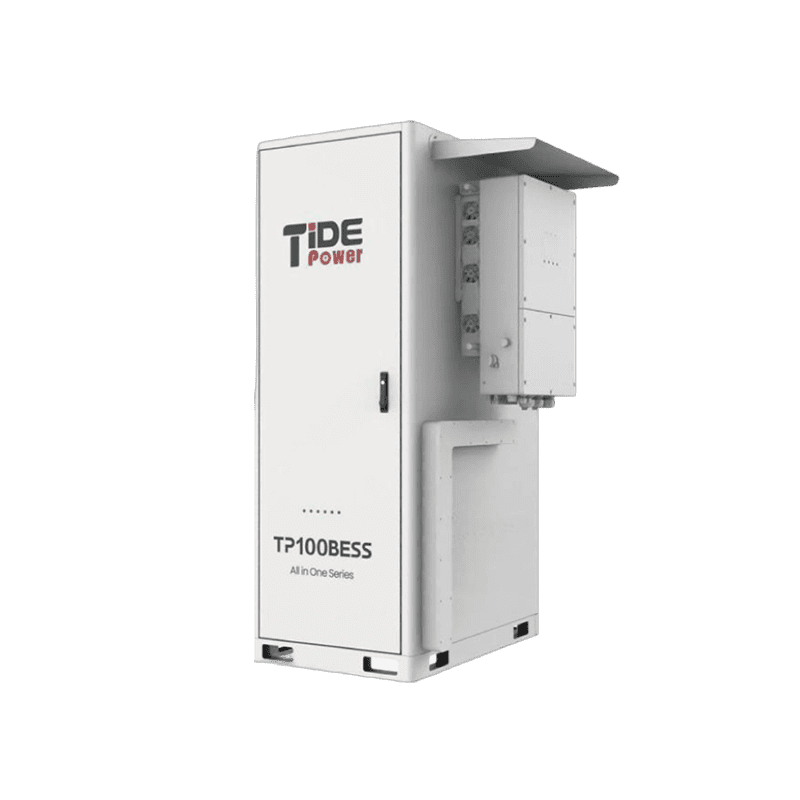
Hybrid configurations change the shape of the running cost rather than removing a line from it. The engine runs at a steady efficient load to charge the pack, then stops, which cuts idle hours and fuel burned per delivered kWh. The saving depends on how closely the dispatch strategy matches the load profile, and that is a question for measured data from a comparable site rather than a brochure claim.
When Is Diesel Still the Better Choice
The core advantage of diesel is refuelling rate. A tank refills in minutes and stores enough energy for several nights, while a battery needs hours on a charger. Any site where the lighting window is longer than the charging window, or where the charge supply is unreliable, remains a diesel site until the logistics change.
Long shifts with high delivered light across a wide area push the same way, because energy density matters more as the load grows. Cold, dust and vibration also favour an engine and a tank over a pack, and a set can be serviced on site with ordinary tools.
Long duty cycles put the service life of the equipment ahead of the purchase price. <Tide Power: Built to Power – Built to Last> covers long service life as part of the equipment value proposition.
Noise and emissions draw the boundary in the other direction. A sound-attenuated set can meet a boundary noise limit in many locations, and its measured level at a stated distance is the number to check. Battery towers produce no engine noise at the point of use, which matters more than the decibel figure when the tower stands beside housing. Indoor and tunnel work usually rules out an engine in the work zone, whatever its enclosure.
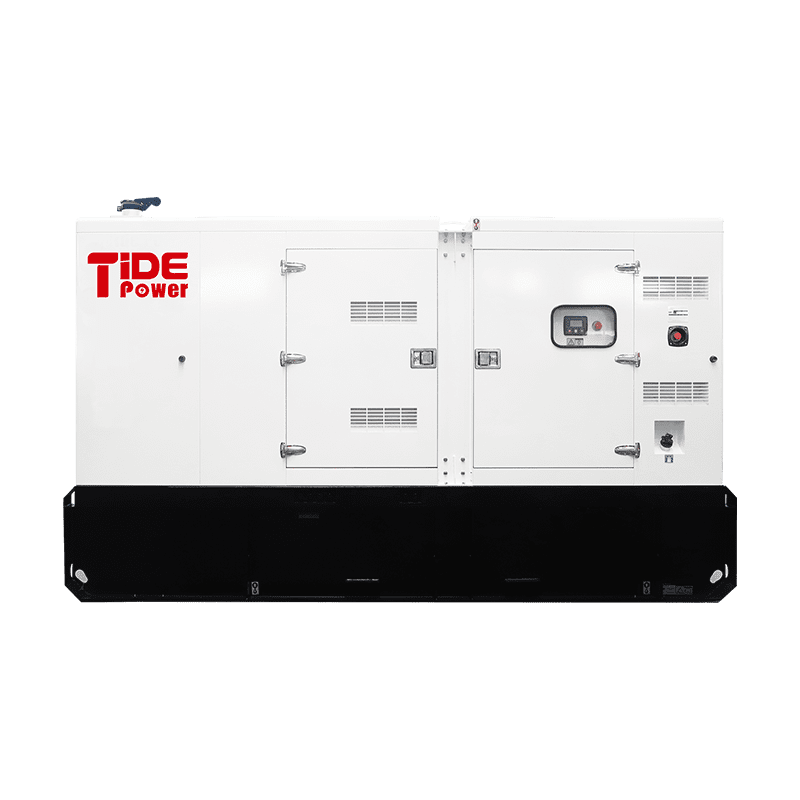
Duty cycle decides more than preference. A tower that runs four hours a night for a week is a poor use of a diesel set, because the engine spends its life starting, idling and stopping. A tower that runs twelve hours a night for two years is a poor use of a battery, because the pack approaches its cycle limit while the site is still active. The break-even sits where the charging window, the fuel logistics and the cycle life meet, and it moves with local fuel and electricity prices.
Which Numbers Should You Request Before Comparing Quotes
A quote is a screening document. It establishes price and scope; it does not establish that two options deliver the same service. Accepting a comparison means checking five or six numbers on a common basis, and the table below separates what suppliers normally measure from what they normally claim.
| Comparison point | Normally measured or certified | Normally only claimed | Do not infer |
|---|---|---|---|
| Light output | Illuminance at defined points with a stated distance and mounting height | A fixture lumen rating or an area coverage figure | Do not infer coverage area from lumens alone |
| Runtime | Hours at a stated load and ambient temperature | An “up to” runtime with no load stated | Do not apply a warm-climate runtime to a winter night |
| Fuel use | Consumption at stated load points | A single fuel efficiency statement | Do not assume part-load consumption scales linearly |
| Battery energy | Usable kWh at a stated depth of discharge and temperature | Nameplate kWh | Do not treat nameplate capacity as energy available at the mast |
| Engine rating | Rating class declared against ISO 8528-1 | A bare kW figure | Do not compare kW across different rating classes |
| Emissions | Type-approval or certificate for the engine family | Low emission wording | Do not assume one market’s approval satisfies another market’s rule |
Ask for these in writing before scoring two quotes against each other:
- Illuminance at defined points, with measurement distance, mounting height and lamp count stated.
- Runtime at a stated load and ambient temperature, not an “up to” figure.
- Fuel consumption at stated load points, so part-load behaviour can be estimated rather than assumed.
- Usable battery energy at a stated depth of discharge and temperature, plus charge time and charging input.
- Engine rating class against ISO 8528-1, alongside the emissions approval for that engine family.
- Noise level with the measurement distance and conditions attached.
- Warranty and replacement terms, including any capacity retention figure for the battery.
One boundary is worth stating plainly. Illuminance measured at the mast is not illuminance on the work face, and a supplier cannot certify your lighting design from a catalogue. Ask for the calculation method, then verify on site after the first night. The same applies to runtime: a figure measured on a warm afternoon does not transfer to a winter night without correction.
What to Send for a Cost Comparison on Your Site
Send the site conditions with the enquiry and the comparison can start from your duty cycle instead of a generic specification. The useful fields are hours per night, nights per season, required illuminance and the task being lit, ambient temperature range, fuel availability and delivery cost, charging supply, the noise limit and the distance at which it is measured, transport limits on mast and tow configuration, and the ownership horizon you are planning against.
Email those details to [email protected] or call +86 591 2806 8999. Tide Power can compare its diesel, battery and hybrid lighting configurations against that duty cycle and quote the equipment and commissioning scope. The company does not certify site illumination design, so the final acceptance measurement stays with your own survey.
FAQ
Is an LED light tower cheaper to run than a diesel light tower?
The question mixes two axes. LED reduces the electrical load needed for a given light level, so it lowers fuel burn or battery draw on any tower. Diesel describes the energy source, and the source sets the running cost structure: fuel price, fuel logistics and engine service on one side; charging energy and battery replacement on the other. A diesel tower with LED lamps is often the cheapest option to run on long shifts in cold or remote conditions, while a battery tower with LED lamps wins on short, noise-restricted work where charging is available.
How long does a diesel light tower run on one tank?
It depends on tank volume, load and ambient temperature, so a single figure rarely transfers between sites. Ask for consumption at stated load points and the usable tank volume, then divide the two. Cold weather raises consumption and can reduce usable fuel if the tank is not protected. Part-load running is less efficient per kWh than running near the efficient band, so an oversized set can burn more than its rated figure suggests. Log the first week of real runtime before fixing a refuelling schedule.
Do solar light towers work in winter or at high latitude?
They work where the array and battery are sized for the worst month rather than the annual average. Winter reduces solar yield and cold reduces battery output, so a system sized on summer data will underperform just when the site needs it. The practical arrangement is a hybrid: solar and battery carry the load in good weather and a generator covers the shortfall, which also protects the pack from deep discharge. Ask for usable capacity at the expected night temperature and for the winter yield assumption in writing.
Which option suits noise-sensitive or indoor work?
Battery and hybrid towers, because the engine can be stopped or sited away from the work face. For outdoor work next to housing, a sound-attenuated diesel set can still comply when its measured level at the stated distance is below the local limit, so check the limit and the measurement basis before ruling diesel out. Indoor and tunnel work is different: engine exhaust in the work zone is usually unacceptable at any enclosure rating, which leaves battery configurations and remotely sited power.
References
[1] U.S. Department of Labor, Occupational Safety and Health Administration, “Illumination,” 29 CFR 1926.56, Washington, DC, USA.
[2] ISO 8528-1:2018, “Reciprocal internal combustion engine driven alternating current generating sets. Part 1: Application, ratings and performance,” International Organization for Standardization, Geneva, Switzerland, 2018.
[3] Regulation (EU) 2016/1628 of the European Parliament and of the Council on requirements relating to gaseous and particulate pollutant emission limits and type-approval for internal combustion engines for non-road mobile machinery, European Union, 2016.
If you’re interested, check out these related articles:
Join Tide Power at bauma CHINA 2024
Beyond Generation: Tide Power’s Integrated Energy Solutions & Tailored Service
Tide Power Set to Make Waves at 2024 Middle East Energy Exhibition (MEE)
Diesel Pump Generators: Reliable Dewatering Solutions for Harsh Environments
Tide Power Recognized as One of Top Manufacturers by IMIR Market Research