 EN
EN ZH
ZH FR
FR ES
ES AR
ARSelecting a silent light tower for an outdoor event requires balancing noise restrictions, illumination needs, and power availability—factors that event organizers often navigate without clear industry guidance. A diesel generator’s 75-decibel rumble can disrupt a wedding ceremony or a corporate keynote, yet many standard lighting towers prioritize raw output over acoustic footprint. Silent light tower options for events now span solar, battery, and advanced low-noise diesel designs, each with distinct tradeoffs in runtime, cost, and deployment complexity. The right choice depends on your venue’s noise limits, the event duration, and how much setup flexibility you need.
How Quiet Does an Event Light Tower Need to Be?
In our work with event organizers across different regions, noise complaints consistently rank as a top concern. Municipal noise ordinances for outdoor events commonly set a limit of 60 to 65 dB at the property boundary, particularly when events run past 10 PM. A standard diesel light tower without acoustic treatment typically produces 70 to 75 dB at 7 meters, which is enough to draw complaints from neighbors and distract guests.
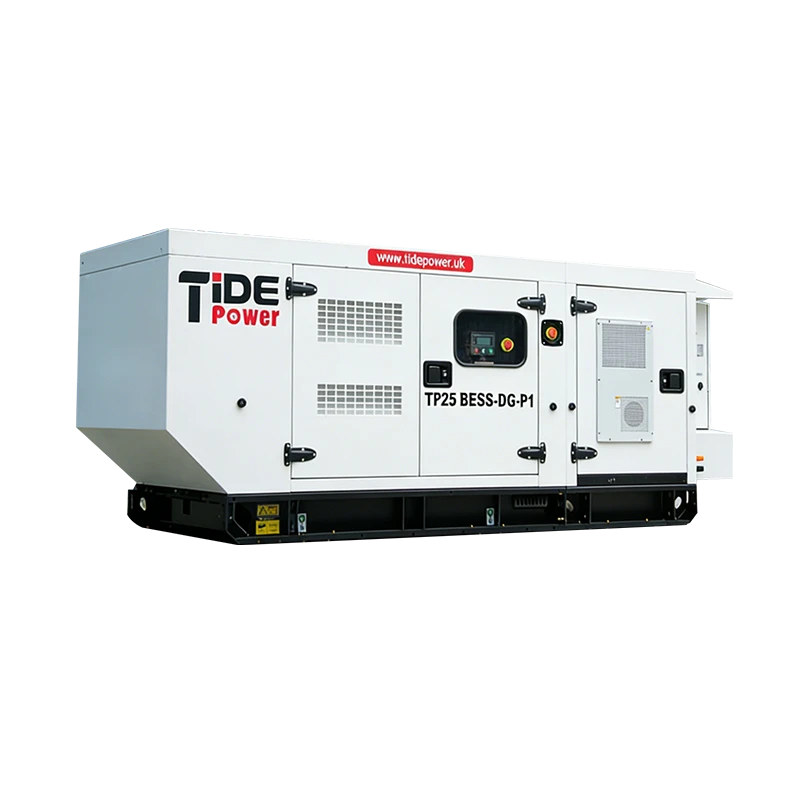
For events where the soundscape matters—weddings, acoustic concerts, corporate presentations—a light tower that stays below 60 dB is no longer a luxury. Solar and battery-only towers operate almost silently, often measuring under 50 dB. Even diesel models with soundproof canopies, such as Tide Power’s hydraulic lighting tower range, bring noise down to approximately 60 dB, comparable to the level of a normal conversation. Checking local noise regulations early in the planning process and matching them to the tower’s published dB rating avoids last-minute restrictions.
What Power Source Options Are Available for Silent Operation?
Silent light towers draw from three main power sources. Each suits different event profiles and site constraints.
| Power Source | Typical Noise Level | Continuous Runtime | Best For |
|---|---|---|---|
| Solar with battery | <50 dB | 8–12 hours (battery), unlimited with strong sun | Eco-conscious events, daytime charging available |
| Battery only (rechargeable) | Silent | 4–8 hours per charge | Short evening events, no fuel allowed on site |
| Low-noise diesel (soundproof) | 55–65 dB | 24+ hours with refueling | All-night events, high illumination demand |
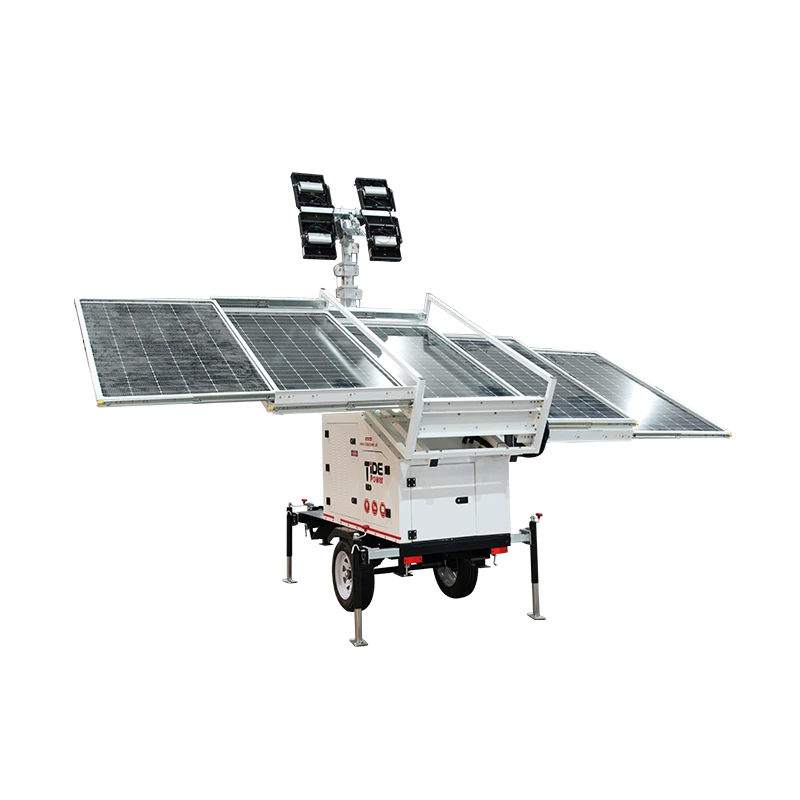
Solar-battery systems work well for venues that want zero emissions and silent operation. Tide Power’s Solar Hydraulic Lighting Tower pairs high-efficiency photovoltaic panels with battery storage, providing enough overnight power for a typical evening event. However, consecutive cloudy days reduce available recharge capacity, making a backup diesel worth considering for long-duration or winter events.
Battery-only towers offer complete silence and easy permitting but demand careful runtime planning. Recharge cycles may require generator support if the event extends beyond a single evening.
Soundproof diesel towers remain the workhorse for festivals and large outdoor conferences. Their acoustic enclosures and redirected exhaust keep noise to conversational levels while delivering uninterrupted power for days. The tradeoff is fuel logistics and a slightly higher noise floor, but for events that need reliable, all-night illumination, they are the most predictable option.
What Key Features Affect Setup and Reliability?
Event planners often underestimate the time and effort that mast design and mobility impose on tight production schedules.
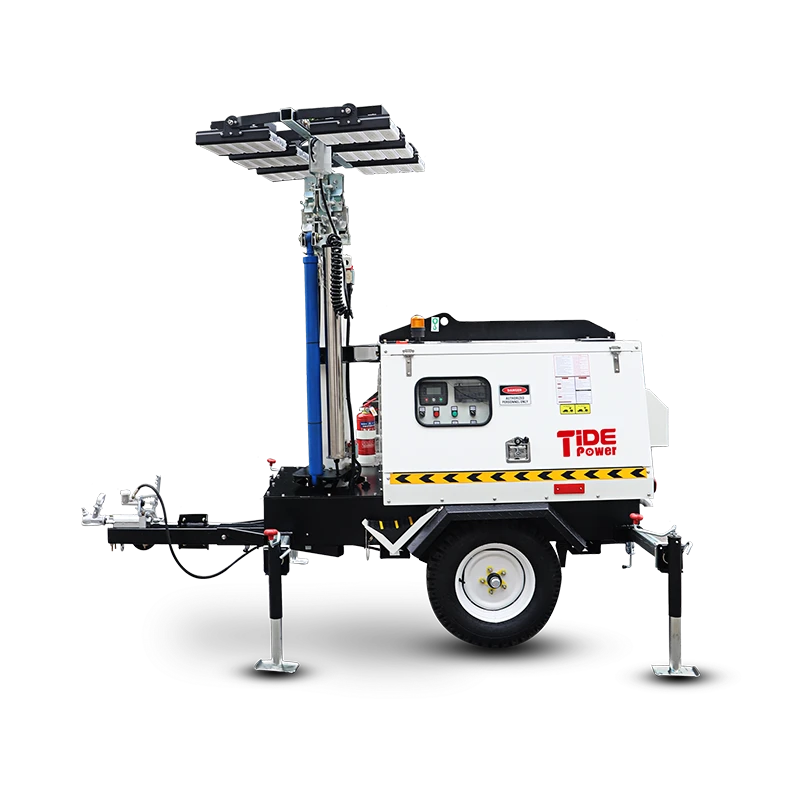
Hydraulic masts, like those on Tide Power’s hydraulic lighting towers, can raise a high-output LED array to full height in under a minute. Manual mast systems, while lighter and simpler, require several minutes of hand-cranking and can delay setup when multiple towers need positioning. For events that must load in and strike within a narrow window, hydraulic speed translates directly into lower labor cost and less stress.
LED floodlights matter for both reliability and power efficiency. Compared to metal-halide lamps, LEDs draw less current, generate less heat, and tolerate vibration better when the tower is moved between sites. They also pair well with solar and battery systems because their lower power consumption extends runtime.
Portability features to look for: towable chassis for road transport, fork pockets for final positioning by site machinery, and weather-sealed control panels. A tower that can be quickly redeployed mid-event if the wind shifts or a stage reconfiguration is needed gives production teams far more flexibility.
If your event site has tight access or requires non-stop lighting for over 12 hours, confirming the exact runtime, mast reach, and noise profile before booking is critical. Reach out at [email protected] for a specification review based on your floor plan.
Which Light Tower Fits Which Event Profile?
Matching the tower to the event’s character avoids mismatches that guests notice.
For weddings and private celebrations, silence dominates every other requirement. A solar-battery tower with warm-temperature LEDs creates an elegant ambience without a single engine note. The compact footprint also stays out of sightlines.
Corporate galas and brand activations demand clean, professional aesthetics. Battery-only towers keep zones completely silent and emission-free, which aligns with ESG narratives that many companies now expect from their vendors. Charging logistics become manageable when events are contained to a six-hour evening.
Music festivals and large outdoor shows need sheer lumen output across broad areas. Soundproof diesel towers with multiple masts, possibly linked for uniform coverage, provide the reliability and runtime that multi-day schedules demand. In these environments, a 60 dB tower is nearly inaudible once crowd noise exceeds 80 dB, but it still meets off-stage and parking-lot noise compliance.
Portable towers with quick-deploy masts fit car shows, night sports events, and pop-up markets where crews may reposition lights between acts or heats. Compact, towable units that one person can operate give event managers independence from heavy equipment.
Should You Rent or Purchase, and What Are the Costs?
One-off events nearly always favor rental. The organizer avoids capital outlay, depreciation, and storage logistics. Rental rates vary by tower type and duration, but many providers offer package pricing for multi-tower setups. Purchase becomes viable when an organization runs multiple events annually—production companies, large-scale venues, and rental houses that wish to grow their own fleet. Owning standardizes the equipment and simplifies maintenance scheduling.
Tide Power supports both paths. Our team helps event companies and rental operators select the right tower configuration and explore long-term procurement options when purchase makes financial sense.
Choosing the right silent light tower prevents noise violations and ensures your event runs without dark spots. We work with event planners and production directors to match lighting to site conditions and budget. Send your event date, venue layout, and lighting requirements to [email protected] or call +86 591 2806 8999. Our team will confirm availability and recommend the most appropriate silent light tower for your project.
Common Questions About Silent Light Towers for Events
How many silent light towers do I need for an outdoor event?
A single 9 kW LED light tower typically provides effective illumination for 4 to 5 acres. For a 10-acre wedding lawn, two towers placed on opposite sides cover the main assembly area and walkways. The exact number depends on mast height, desired lux levels, and whether the event has stages, dining areas, and parking zones that all need light. A site plan shared with a supplier turns general guidelines into a precise count.
Can a solar light tower provide enough light for an all-night event?
Yes, when battery capacity is properly sized for the expected load. Tide Power’s solar hydraulic towers include battery storage designed to sustain LED operation through a full evening event. For events spanning multiple days with limited sunlight, the system can integrate a small backup diesel generator that only activates when battery charge drops, preserving silent operation most of the time. This hybrid approach is increasingly common for off-grid festivals.
What is the quietest light tower available for events?
Pure solar-battery towers produce almost no sound, with noise levels well under 50 dB. Even soundproof diesel towers from Tide Power incorporate acoustic enclosures and redirected exhaust that bring measured noise to approximately 60 dB at 7 meters, similar to the level of normal conversation. The actual perceived noise on site also depends on wind direction and surrounding structures, so discussing your venue layout with a technical specialist helps set realistic expectations.
How long does it take to set up a silent light tower?
Hydraulic mast models can be deployed in under five minutes from arrival to full illumination, including outrigger stabilization. Manual mast towers may take ten to fifteen minutes, depending on the number of units and the crew’s experience. For events with narrow load-in windows, the time saved by hydraulic lifting often outweighs the modest cost difference. Share your event requirements and we’ll confirm the best silent light tower configuration for your schedule.
If you’re interested, check out these related articles:
How to waterproof diesel gensets in spring and summer when there is a lot of rain?
Power the Future with Tide Power at Electric & Power Indonesia 2025!
150 diesel generator sets supporting the construction of telecommunications projects in Africa
Tide Power: Clean Energy, Built to Work
?Thank You for Joining Us at Electric & Power Indonesia 2024