 EN
 ZH
 FR
 ES
 AR
A 5kW hybrid solar system is defined by four numbers, not one. The 5kW in a model name usually describes continuous AC output, while the array is rated in kWp, the battery in kWh of stored energy, and surge capability in a short-duration overload figure that tends to sit further down the datasheet. Systems compared on the headline kW alone show the gap at commissioning, when a pump motor starts or an evening load runs longer than the battery can carry. The checks below set out what to fix in writing before a quotation becomes an order.
What Does 5kW Actually Describe in a Hybrid Solar System?
In a hybrid system, power passes through several conversions. The PV array feeds a DC bus, the battery buffers that bus, and an inverter produces AC for the load. A generator or the grid may feed the same bus for charging. Each conversion has its own rating, and model names usually quote only the inverter’s continuous AC output, because that is the figure a buyer can compare against appliance loads.
Power factor is the first place the number can mislead. A 5kW inverter rated at unity power factor delivers 5kW to a resistive load. A load drawing 5kW at a power factor of 0.8 needs about 6.25kVA, so a unit rated 5kVA runs at its limit while a unit rated 5kW at 0.8 power factor does not. Check whether the datasheet states kW, kVA, or both, and at what power factor.
| Rating | Where it appears | What it constrains |
|---|---|---|
| Continuous AC output | Headline specification, often without conditions | Which loads run together and what the unit delivers on a hot afternoon |
| PV array size in kWp | PV input section | Daily yield and string configuration, not instantaneous output |
| Battery energy in kWh | Battery section, with or without a usable figure | Hours of supply after sunset and overnight autonomy |
| Surge or short-time overload | Overload curve, sometimes omitted | Motor starting and simultaneous load switching |
Architecture changes what the rating means as well. An all-in-one unit packages inverter, MPPT charge controller and battery in one enclosure; a split system separates them, which allows a larger battery or a different inverter later. Tide Power’s all-in-one hybrid power stations start at 10kVA (TP-10P) with LFP battery modules from 5.12kWh, so a 5kW continuous load sits below the smallest all-in-one model and usually becomes a choice between a split system and a larger unit bought with growth headroom.
Whatever the architecture, the four ratings belong on the quotation with their conditions, and the derating table for ambient temperature belongs beside them. A 5kW continuous rating at 25°C is not the same promise as 5kW at 45°C, which is what a container or a poorly ventilated plant room reaches.
Matching Your Load Profile to a 5kW Rating
Start with the load, not the inverter. Two sites with the same 5kW peak can need very different batteries: one runs a 3kW heater for two hours, the other runs 600W of communications equipment around the clock.
Convert every load to daily energy with daily kWh = sum of (watts × hours) ÷ 1000. A 200W load running 24 hours takes 4.8kWh a day. Four such loads take 19.2kWh a day, which is more than a single 5kWh battery module supplies at any depth of discharge.
Then separate continuous demand, peak demand and its duration, and motor starting current. Direct-on-line induction motors draw several times their running current during start, and the multiple sits on the motor nameplate as locked-rotor current. That figure, not the running watts, decides whether a 5kW inverter with a short-time overload rating of twice nominal for a few seconds can start a given pump.
Apply a diversity factor you can defend and record the assumption. Commissioning rarely matches a spreadsheet built from nameplate totals. On an existing site, a clamp meter or logger recording over several days carries more weight than an appliance list, because it captures the simultaneous peaks that a list hides.
PV Array and MPPT Window Checks for a 5kW Inverter
The array is sized in kWp and the inverter in kW, and the two do not have to match. A DC to AC ratio slightly above 1 is common on hybrid systems, because array output rarely holds at nameplate for long. Whether the extra array is worth the additional yield is a design choice, not a specification requirement.
String voltage is where many 5kW designs fail a check. The highest open-circuit voltage a string reaches on the coldest expected morning must stay below the inverter’s maximum DC input. Module datasheets give a Voc temperature coefficient, and it is negative for crystalline silicon, so string voltage rises as temperature falls. Use the datasheet coefficient and the site’s minimum design temperature rather than an average day.
At the other end of the range, the string’s maximum-power voltage at the hottest cell temperature must stay above the inverter’s MPPT start voltage, or the array sits idle through the hottest afternoon. MPPT windows differ between models in the same 5kW class, so string design follows the actual datasheet rather than the class.
Shading belongs in the same calculation. A string with one shaded module loses more than that module’s share, and a hybrid inverter cannot recover the loss by charging the battery harder later.
Battery Bank Specifications and Usable Energy at 5kW
Battery current is the check most often skipped. A 5kW discharge from a 48V nominal bank draws about 104A (5000 ÷ 48). Cables, fuses, busbars, the BMS and the inverter’s DC input must carry that current continuously, not only during a surge. A higher-voltage battery architecture reduces the current for the same power, which is one reason rack batteries above 48V appear in larger hybrid systems.
Nameplate kWh is not usable energy. Usable energy depends on the depth of discharge the manufacturer allows, the operating temperature, and the capacity the pack still holds at end of life. Ask for usable kWh at the discharge rate and temperature your site will see. A bank declared at 5kWh that delivers close to its rating at a light load delivers less when a full 5kW load pushes the discharge rate up.
Lithium iron phosphate packs and lead-acid banks behave differently under the same label. Lead-acid banks are usually limited to a partial depth of discharge to preserve service life, while LFP packs often publish a higher usable share. Use the figure for the exact model rather than the chemistry in general.
Certification scope needs reading as carefully as the capacity. IEC 62619 covers safety requirements for lithium cells and batteries in industrial applications, and it does not establish cycle life, throughput or a warranty [1]. UL 9540 is a system-level listing tied to a specific combination of enclosure, battery and controls, so a listing for one configuration does not transfer to another [2].
Put the end-of-life criterion in the contract before signing. A capacity threshold at a stated test condition gives you something to measure against later; a cycle count on its own does not.
Battery sizing is usually where a 5kW design is won or lost. <Compact BESS: Your Intelligent Route to Energy Independence and Cost Efficiency> covers how compact battery storage is positioned for sites that want to reduce diesel runtime.
Inverter, Transfer and Grid Interface Checks
Conversion efficiency is usually quoted at peak, which falls somewhere in the middle of the load range. Ask for the weighted efficiency figure if the datasheet provides one, and check where your typical load sits on the curve. A unit run near full output for hours each day will not match its peak number.
Transfer time matters when the load includes IT equipment, controls or a laboratory instrument. A transfer measured in milliseconds keeps most electronic loads running; a longer break restarts them. Get the figure and its test condition, then decide whether the load tolerates the break.
Grid interaction is a separate compliance track. IEEE 1547 sets interconnection requirements for distributed energy resources in North America [3], and IEC 61727 addresses the utility interface for PV systems in other markets [4]. Anti-islanding protection forms part of both. Confirm which standard the local utility requires before ordering, because it changes protection settings, firmware and sometimes the inverter model itself.
Converter safety is covered separately by IEC 62109-1 for general requirements and IEC 62109-2 for inverters [5][6]. The certificate should name the exact model and the standard edition, not a product family.
Also confirm the generator input window, two-wire start capability, the ingress protection rating against the mounting location, and whether the model can be paralleled later for a second unit or a larger battery.
Grid rules change protection settings and firmware, not just paperwork. <Building the Resilient Grids of Tomorrow: Tide Power’s Microgrid and Utility-Scale Energy Storage Solutions> covers microgrid and utility-scale storage integration.
Sizing a Backup Generator for a 5kW Hybrid System
The generator in a hybrid system does two jobs: it carries the load the inverter passes through while it charges, and it refills the battery within an acceptable run time. Sizing on the 5kW inverter rating alone leaves both jobs half done.
Add the two loads. A 48V bank accepting 50A of charge draws about 2.4kW at the battery terminals (48 × 50 ÷ 1000), and charger losses push the generator input above that. Add the site load that must run during charging, then add margin for starting and for ageing. A generator sized only for the site load takes a long time to refill a depleted battery; one sized only for charging will not carry the load.
Diesel engines kept at light load for long periods run inefficiently and can suffer incomplete combustion. The practical fix is to size the unit to the charging load and the real site demand together, and to avoid a generator far larger than both.
Control is the next detail. The inverter needs a two-wire start signal and a generator support setting that matches the unit’s voltage and frequency window. Test the sequence, including a failed start and a low battery alarm, before the site goes live.
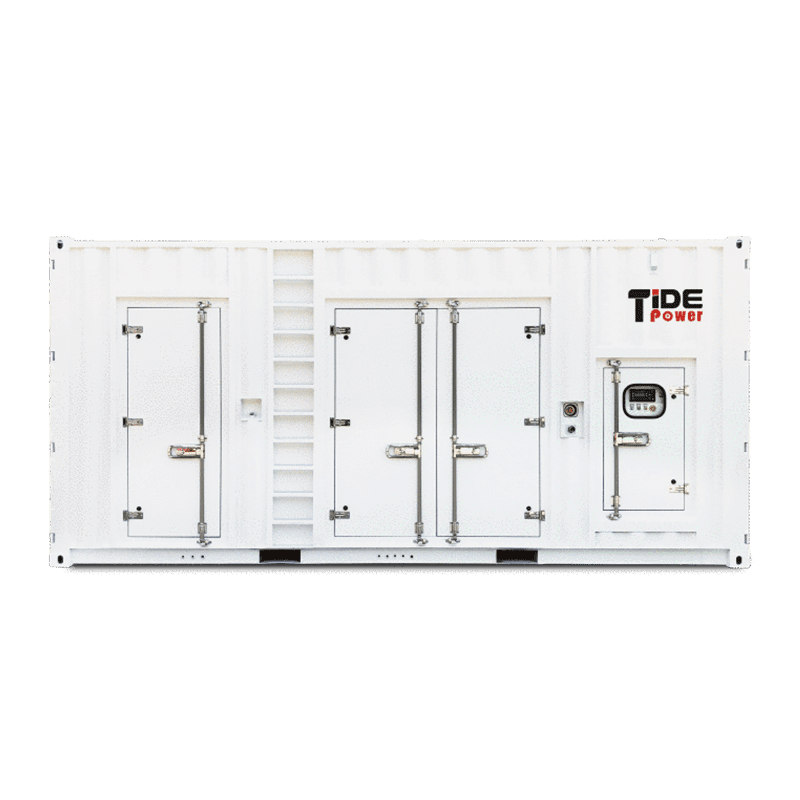
Enclosure choice follows the site. A containerized set suits dusty, hot or coastal locations where equipment needs protection and service access, while an open set suits a plant room with its own ventilation and acoustic treatment.
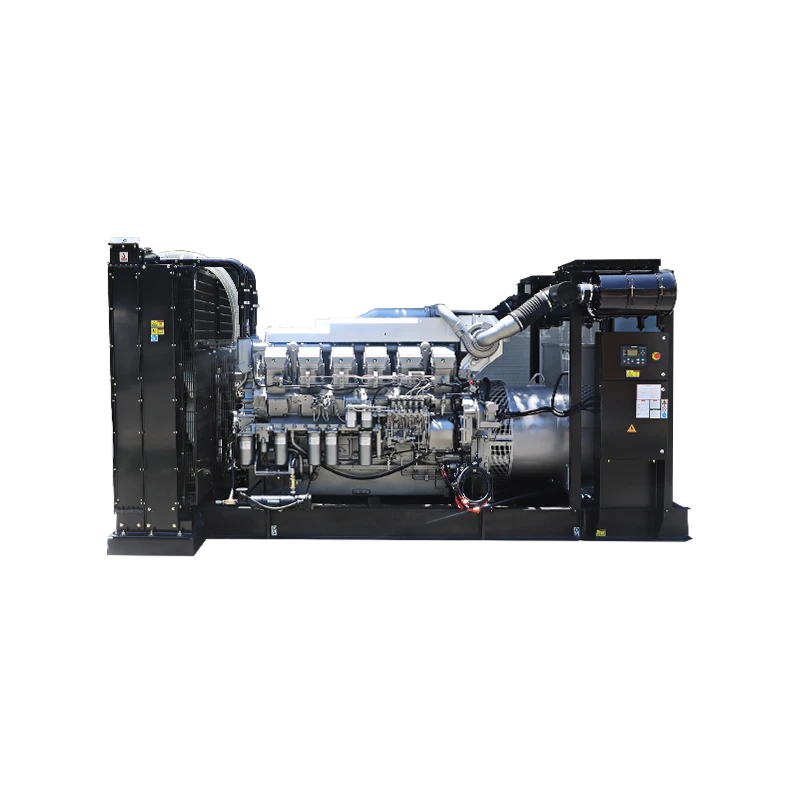
Generator selection follows the charging load as much as the site demand. <How to Choose a Generator at Tide Power> covers the generator selection process.
RFQ Fields and Acceptance Documents Before You Order
Vague enquiries produce vague quotes, and the gap surfaces after delivery. The pattern below is common.
Reject this line: “5kW hybrid solar system, 10kWh lithium battery, please quote.”
Replace it with: “5kW continuous AC at 45°C ambient and 0.8 power factor; load profile attached with peak and starting currents; PV array 6kWp with string Voc at minimum design temperature; usable battery energy at stated depth of discharge and C-rate; off-grid with generator input; certificates to IEC 62109-1 and IEC 62619 with edition and model listed.”
| Field | What to request | Why the omission costs money |
|---|---|---|
| Output basis | Continuous kW and kVA at a stated ambient temperature and power factor, plus the derating curve | A rating quoted at 25°C can fall below the load on a hot afternoon |
| Load profile | Continuous demand, peak demand with duration, daily kWh, locked-rotor current of every motor | Sizing on total connected watts undersizes surge and undershoots overnight energy |
| PV interface | MPP voltage window, maximum DC input voltage and current, number of MPPTs | Strings outside the window either trip on cold mornings or stall in heat |
| Battery | Chemistry, nominal voltage, usable kWh, maximum continuous charge and discharge current, BMS limits | Declared kWh may not be deliverable at the current a 5kW load needs |
| Interface and control | Single-phase or split-phase output, transfer time, generator start type, grid code required | Protection settings and transfer behaviour cannot be retrofitted cheaply |
| Compliance package | Certificate number, standard edition, listed model, listing configuration | A scope-level certificate may not cover the configuration you are buying |
Read the documentation in the same way, separating what each record proves from what it does not.
| Record | Method context | Responsible use | Do not infer |
|---|---|---|---|
| IEC 62109-1 certificate [5] | Converter tested as a power converter for PV systems | Confirms the named model meets general converter safety requirements | Does not prove it meets your utility’s interconnection rules or carries your surge load |
| IEC 62619 test report [1] | Cell and battery safety tests for industrial lithium applications | Supports safety claims for the tested cell or battery | Does not establish cycle life, throughput or usable energy at your site temperature |
| UL 9540 listing [2] | System-level listing of a specific storage configuration | Supports the listed enclosure, battery and controls as a package | Does not transfer to a different battery, enclosure or installation method |
| Supplier cycle-life figure | A declared number of cycles at a stated depth of discharge, temperature and charge rate | A comparison basis only when the test conditions are identical | Does not mean the same cycle count at a different depth of discharge or inside a hot enclosure |
| Factory load test report | Unit run at a stated load and ambient condition | Shows the unit reached that load under those conditions | Does not prove performance at site altitude or in a 45°C container |
Commissioning then supplies the evidence a datasheet cannot. Record the string open-circuit voltage against your calculated cold-morning maximum, insulation resistance and earth continuity on both DC and AC sides, a load test at continuous rating, a transfer test with the real critical load, the generator start and charge sequence including a simulated failed start, and the protection settings and firmware version in the as-built file.
Send Your Load Profile Before You Approve a 5kW Design
Send the load profile with the enquiry, not after the order. Tell us the continuous and peak demand with durations, daily kWh, the locked-rotor current of every motor, site ambient and altitude, the PV array kWp with string voltages, the battery chemistry and usable kWh you need, whether the site is off-grid or grid-tied and which grid code applies, and any certificate numbers the project requires. A single kW figure cannot be checked against a site, and the four ratings behind it decide whether the system carries the load in the conditions you actually have.
Michael Chen
Tide Power Technology Co., Ltd.
[email protected]
+86 591 2806 8999
FAQ
Is a 5kW hybrid solar system enough for a house?
It depends on daily energy rather than peak demand. A 5kW inverter with a well sized battery runs lighting, refrigeration, electronics, a water pump and a workshop comfortably on most days. The limit appears with thermal loads: a heater or air conditioner drawing 3kW to 4kW for several hours empties a small battery quickly and outruns the array’s daily yield. Compare your daily kWh and overnight demand against the array’s expected output for your location and season before deciding.
How many solar panels does a 5kW hybrid system need?
The count follows the array size you choose, not the inverter rating. If the array is sized at 5kWp and each module is 400W, the count is 12.5, so 13 modules; with 550W modules it comes to about 9. The count matters less than the string configuration. Check that the resulting string voltages stay inside the inverter’s MPPT window across your temperature range, and that the roof or ground space allows the orientation the array needs.
What battery capacity should I pair with a 5kW inverter?
Work from daily energy and autonomy, then divide by the declared usable share: usable kWh needed = daily kWh × autonomy days ÷ usable share. A site using 8kWh a day with two days of autonomy at a declared usable share of 0.9 needs about 17.8kWh (8 × 2 ÷ 0.9). Then check discharge current, because a 5kW load from a 48V bank draws about 104A and the BMS, cabling and fuses must carry it continuously.
Can a 5kW hybrid system run a pump or an air conditioner?
Starting current decides, not running watts. A pump with a locked-rotor current several times its running current may stall a 5kW inverter whose overload rating lasts only a few seconds, while a soft starter or a variable speed drive can bring the same pump inside the limit. Check the motor nameplate, the inverter’s overload curve with its duration, and whether the compressor or pump starts against pressure, since that raises the starting demand.
References
[1] IEC 62619:2022, “Secondary cells and batteries containing alkaline or other non-acid electrolytes – Safety requirements for secondary lithium cells and batteries, for use in industrial applications,” International Electrotechnical Commission, Geneva, 2022.
[2] ANSI/CAN/UL 9540, “Energy Storage Systems and Equipment,” UL Standards and Engagement, 2023.
[3] IEEE 1547-2018, “IEEE Standard for Interconnection and Interoperability of Distributed Energy Resources with Associated Electric Power Systems Interfaces,” IEEE, Piscataway, NJ, 2018.
[4] IEC 61727:2004, “Photovoltaic (PV) systems – Characteristics of the utility interface,” International Electrotechnical Commission, Geneva, 2004.
[5] IEC 62109-1:2010, “Safety of power converters for use in photovoltaic power systems – Part 1: General requirements,” International Electrotechnical Commission, Geneva, 2010.
[6] IEC 62109-2:2011, “Safety of power converters for use in photovoltaic power systems – Part 2: Particular requirements for inverters,” International Electrotechnical Commission, Geneva, 2011.
If you’re interested, check out these related articles:
Ultimate Flexibility: Tide Power’s Foldable Container Delivers Portable Answers to Global Power Challenges
Successful 2024 Half-Year Global Sales Meeting for Tide Power
Tide Power & Caterpillar Special Exchange Meeting Concludes Successfully!
Tide Power and Caterpillar Successfully Signed 2024 MWM Engine Purchase Intent Agreement