 EN
EN ZH
ZH FR
FR ES
ES AR
ARConstruction site dewatering sets the conditions for everything that follows. A pumping decision made before excavation begins can either hold the project schedule together or introduce recurring delays. The most useful approach is not to move water as fast as possible; it is to match pumping method, ground conditions, and site power as one system, because the interfaces between them create most failures. On projects I have worked on, the contractors who treated dewatering as a schedule risk rather than a catalogue decision controlled groundwater earlier and with less rework. This article covers the methods, pump specifications, and failure points that site teams handle before the first excavator enters the pit.
Why Does Construction Site Dewatering Control the Schedule?
Groundwater does not announce itself as a single problem. It shows up as a trench that will not hold grade, a foundation base that stays soft, or a discharge flow that changes after rain. Site teams feel it first as lost excavation time. When dewatering is treated as an afterthought, equipment waits, concrete pours move, and crews make rushed decisions that later need rework.
This is why I group dewatering with access roads and temporary power. The water table, soil permeability, and discharge point have to be understood before the excavation sequence is committed. In projects where I supplied self-priming diesel pump sets, the most consistent schedule gain came from placing the pump close to the first cut and matching its suction to the actual ground, not from selecting the largest unit in the range. A large pump in the wrong soil is still a bottleneck.
.png)
Which Dewatering Method Fits Different Ground Conditions?
Equipment choices follow the ground, not the other way around. A diesel pump package that works in open gravel can fail in fine silt because the suction conditions change. Method selection decides whether a site stays dry enough for crews to work.
| Method | Ground conditions | What it does well | Where it struggles |
|---|---|---|---|
| Sump pumping | Shallow, low-permeability clay or silt | Handles small flows with simple setup | Loses effect when the water table is high |
| Wellpoint dewatering | Sandy or silty sand, shallow to moderate depth | Lowers the water table around the excavation | Not ideal for deep or low-yield formations |
| Deep well dewatering | Deeper excavation or permeable soils | Controls larger flows and greater drawdown | Higher cost and longer setup |
| Eductor dewatering | Low-permeability fine-grained soils | Creates vacuum in difficult silty clays | Lower flow efficiency and higher energy use |
What Is Wellpoint Dewatering and When Does It Fit?
Wellpoint dewatering uses a series of small-diameter points connected to a header pipe and a vacuum pump. It works best in sandy or silty sand formations where the water table sits at shallow to moderate depth. The system lowers the water table around the work area, which keeps excavation sides stable and reduces the amount of water that reaches the cut.
When Does a Deep Well System Make More Sense?
A deep well system becomes the preferred route when the excavation goes deeper or the soil passes water too quickly for wellpoints to keep up. Each borehole has a submersible pump inside, so the method can handle larger flow and greater drawdown than a wellpoint line. The tradeoff is longer installation time and more electrical or generator capacity, but that cost is usually justified when the alternative is a flooded excavation bench.
How Do Pump Specifications and Site Power Work Together?
Pump selection on a dewatering job is not about choosing the largest unit in the catalogue. It is about matching flow rate, total head, and what the pump can pass without losing prime. Self-priming diesel units matter because a pump that cannot recover after air enters the suction line creates a silent delay that does not show up on a purchase order.
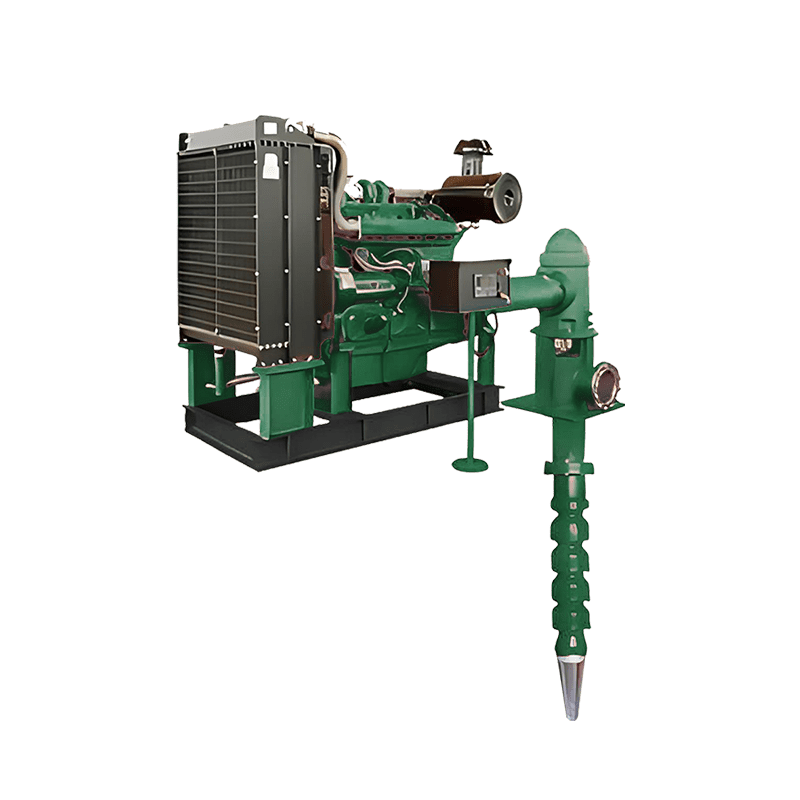
Site power is part of the same decision. An electric pump may look efficient on paper, but if the excavation area does not yet have a stable temporary supply, the pump becomes dependent on cable runs and distribution boards. Diesel engine-driven pump units can be placed close to the water and started without waiting for grid infrastructure. Tide Power’s dewatering pump range follows this logic. The Z, B, K, S, D, and C series are built around self-priming pump bodies and diesel engines, with fast priming, high head, and continuous or emergency operation in mind.
What Pump Performance Numbers Should Site Teams Confirm First?
Total head comes before flow rate. Flow tells you how much water the pump moves under ideal conditions; total head tells you whether it can push that water through the discharge pipe, up an elevation, and past any filtration resistance. Site teams should also confirm self-priming speed and solids tolerance, because both determine whether the pump recovers after air or sediment enters the suction line.
If your project involves silty or variable groundwater, confirm self-priming speed and solids tolerance before finalizing your pump list. Send the site details to [email protected].
Where Do Dewatering Plans Go Wrong on Real Projects?
Most dewatering failures are not pump breakdowns. They are planning failures that become visible only after excavation starts. A crew can operate a perfectly good pump and still lose days if the pump curve does not match the discharge route or the water carries more sediment than the pump can handle.
The most expensive failure I have seen was a clean-water pump set running in silty conditions. The unit lost prime repeatedly, and the excavation crew spent two days resetting suction lines while groundwater returned. The fix was not a bigger engine. It was a self-priming diesel pump with better solids tolerance and a settlement point that kept silt out of the discharge area. That experience changed how I write equipment specifications: I now ask about the dirt before I ask about the flow.
Discharge water can be another hidden failure. A dewatering system may control the excavation but still create a compliance problem if silty water leaves the site without settlement or filtration. The discharge route needs the same attention as the suction route, and it should be confirmed before the first pump starts.
What Should You Confirm Before Finalizing Dewatering Equipment?
Groundwater conditions look simple on paper and become complicated at the excavation face. If your project involves dewatering before foundation work, confirm the water table depth, soil type, discharge point, and total head before locking in a pump package. Then send those numbers, along with your required flow and available fuel or power source, to [email protected] or call +86 591 2806 8999. That gives us the information needed to match the right diesel pump series to the site instead of starting from a catalogue position.
What Do Construction Teams Ask About Dewatering?
How Much Dewatering Capacity Does a Construction Site Need?
Start with the groundwater flow rate into the excavation and the required drawdown depth, not the pump catalogue. A site that only needs to handle thirty cubic metres per hour can often use a compact self-priming unit, while a deep excavation in permeable gravel may need multiple wellpoint or deep well pumps. The number to establish first is total dynamic head, because it combines elevation, pipe friction, and discharge arrangement. Without that figure, flow alone will not predict pump performance.
Can a Construction Project Reuse the Pumped Water?
Many teams assume all pumped groundwater is clean enough to discharge, but that assumption can create regulatory delays. Water from sandy soils may still carry fine sediment, and discharge rules often require settlement or filtration before release. In some locations, treated dewatering water can be reused for dust control or compaction, but only after the site confirms quality and any permits. The decision should be made with the discharge route, not after the pump is already running.
What Is the Difference Between a Dewatering Pump and a Trash Pump?
It depends on what the water carries. A dewatering pump is optimized for clear or lightly silty groundwater and is focused on head and flow efficiency. A trash pump has larger clearance to pass solids, but it may sacrifice pressure and prime recovery. If the excavation has leaves, gravel, or construction debris, a trash pump or a dewatering pump with higher solids tolerance may be the better choice. The two cannot be swapped on a specification sheet without checking what the suction line will actually pick up.
When Should a Site Choose a Diesel Pump Instead of an Electric Pump?
In projects I have worked on, diesel engine-driven pump units are often the better starting point when temporary power is not yet stable at the excavation area. They can be placed close to the water without waiting for distribution boards or cable runs. Electric pumps work well where grid power is reliable and the site wants lower local emissions. The common mistake is choosing electric equipment before confirming the power connection date, because that can create a delay that a diesel unit would have avoided. If your site has silty groundwater or a changing water table, share your flow and head requirements with [email protected] and we can confirm which configuration fits.
If you’re interested, check out these related articles:
“Inciting?sales?in?leading?the?changing?trend”2022?Tide?Power?Global?Sales?Conference was successfully held
GPOWER2023 officially comes to an end, Tide Power looks forward to seeing you again!
Tide Power & MWM Deepen Partnership in Strategic Meeting on Gas Generator and Power Solutions
Tide Power Breaks Ground on New Smart Generation Equipment Manufacturing Hub
Tide Power: Built to Power – Built to Last